Thursday, February 6, 2014

University of the Philippines Prep High School...II


University of the Philippines Prep High School 

 U. P. Prep High School...


The University of the Philippines Prep High School was established in U. P. Manila campus

SKYLINE OF PADRE FAURA TODAY AND THE CARILLON AT THE DILIMAN CAMPUS


The University began with the College of Fine Arts, the College of Liberal Arts, and the College of Medicine and Surgery occupying buildings distributed along Padre Faura (Ermita district) and R. Hidalgo (Quiapo district) in Manila as well as a School of Agriculture in Los Baños, Laguna.

A few years after, the university opened the College of Law and the College of Engineering in Manila, as well as academic units under the College of Agriculture and Forestry in Los Baños. It became necessary for U.P. to establish more academic programs, as well as to expand its facilities.

The Board of Regents approved the need to look for a larger site, and a 493-hectare lot was acquired by the university in Diliman, then a town under the province of Rizal. Construction of the new campus immediately began in 1939

UP Prep was created in 1954, when the UP Board of Regents authorized then UP President Vidal Tan to open a first class high school in Manila.

The school’s high standard curriculum was designed for secondary school graduates with the aptitudes and intellectual talents for university level education. Emphasis on a special curriculum focusing on science and mathematics while forwarding the graduates into UP college programs. The faculty was carefully selected for these advanced subjects, and oh, how I love my teachers… Ms. Galang in Math, Ms. Dayap in Biology and Chemistry, Ms. Cortez in History and many others who deeply instilled in me the value of education.

It was only by passing a battery of rigorous examinations could a student get in, and once accepted, he or she had to hurdle to pass each of the four tough years of the highest standard of education ever given to high school students in the Philippines before one could graduate.

This was a small close knit school among students, where everybody knew each other, and where proper decorum was expected  by  the upperclassmen from the lower years.  Seniority was respected, as if the atmosphere was inside a military academy.

Unfortunately, due to limited resources, in 1973, after graduating 20 classes — comprised altogether of 1500 graduates — UP Prep was merged with UP High School to later become what is now known as UP Integrated High School.  

A poignant oblation photo. My interpretation of my last look and parting with "UPPHS". "Paalam" Prep High

1960: At UP Los Banos with mom and siblings, me in uniform of UP Prep High, khaki pants and white top with logo on left breast. (Photo by papa UPLB BS Forestry class'40). It was a rare event when we all could gather and pose for a moment. They are grown up, mother have left our midst. The glimpse of all of us together brings the emotions of close family ties.

1960: I became aware of my family's heritage at UP Prep and began preparation for entry at Fort Del Pilar (PMA), a military academy in Bagiuo named after my granduncle. A period in my teen years in High School that I remember fondly, of the hectic days, dashing thru the corridors catching my schedule of classes at Rizal Hall. I recall my bag loaded with books, eager, wide eyed, and quick to learn the tenets of math, and the sciences. I remember past friends and stormy situations that most teenagers weathered through. As in life surviving the unspoken pecking order of bigger classmates and the so called in crowd was the rule. That lone wolf streak that kept me apart, which peers seemed to see as a weakness was a measure of heritage that set me off from the current teenage precepts of the day. Later, when of age after further studies, having ever spurred curiosity, like my ancestors did, aspired a life of adventure, of soldiering and foreign lands.

 The happiest of people don't necessarily have the best of everything; they just make the most of everything that comes along their way........Therefore when I see the flowers before me blocking my view, I jump at the thoughts of my youth and then smile to myself...

Tip toe thru the tulips with me
Tip toe from your pillow
To the shadow of the willow tree
And tip toe thru the tulips with me
Knee deep in flowers we'll stray
We'll keep the showers away And if I kiss you in the garden
In the moonlight, will you pardon me
Come tip toe thru the tulips with me.

Manila Harbor, Manila City, and Intramuros, Philippines, early 1960s Notice that this photo was taken before much rebuilding in Intramuros and there is lots of empty land showing just how much of the city was cleared after WWII. The US embassy and the Manila Hotel are shown on the upper right. I relished and missed the traditions followed in a military base (MNS) about a mile to the right of this picture, now occupied by the Central Bank of the Philippines. The site of the old Fort San Antonio Abad was demolished, in favor of the bank, another sacrilege. My recollections of waking up in the morning to the bugle calls to the colors remained fresh in my mind.


A Mini of Class 61 in Northern California. After 47 years we finally meet up with Alex and his lovely wife Marissa. And to think they were living only three blocks away from Cap up to about 3 years ago! It really takes a mini to reconnect. Thanks to Joe for driving all the way from Dublin. Missed Mayette.Thanks to Augie and Violet for finally finding Cap's house while avoiding launching divorce proceedings on the way. The company makes me fully support the plan to organize a reunion as soon as possible. A cruise would be an excellent opportunity to bond once more. Remember we're all in the"pre-departure lounge." ..RC; We give thanks to our host Melchor and Helen for the successful reunion in Vallejo. Most of all to the classmates who came from afar RC and Dudi, Joe de Guzman/son, Augie Capulong and Violet. Our reunion went well all the way to 10PM. The lively discussions were mostly about Politics, about you not present and the next reunion somewhere, sometime soon...ASC

    photo

    RIZAL HALL UPPER LEFT 52 YEARS AGO (1960 AFTER LIBERATION WWII) REBORN LIKE THE PHOENIX

    When we were young we saw the world through simple, hopeful eyes.  We knew what we wanted to be, we had no biases or concealed agendas.  We liked people who are positive.  We avoided unkind people. All have high hopes for the future, but me, preparations were structurally rigid to a fault. Tomorrow was not left to chance.

    One teacher introduced a letter in class just in passing. The classic lines, words and thoughts attracted my attention  to abide by it, but not all, to be honest. Although it was gender specific, it applies somehow. Here, I posted it, for the sake of others, who missed that class…. A transgenerational letter from Barcelona, dated 13 of March 1889

    My dearest niece,

    The vagaries of life, which Providence in its most inscrutable design has alloted to me, had taken me away from that beautiful land where I have left behind the treasures of my life without even giving me a chance to say goodbye to the people I cherish and appreciate. In this letter to you, I shall try to make amends for my precipitate flight, by sending through you this my humble message to the young women of Bulacán. I feel convinced that you have been chosen, and on you depends the regeneration, the rebirth of our town. For there is no doubt of the strength and scope of a women’s influence on the family. Daughter, sister, wife, or mother — a woman offers the balm of solace that makes endurable the rigors of everyday life. More than that, she is the element that guides men to paths of virtue and courage or to the pitfalls of wrongdoing and cowardice.

    In all these countries that I have now visited, I have found eloquent proof that where women are virtuous, vice is timid and dignity predominates in the life of man. But when feminine frivolity reigns, the men are taken up in immorality and the abandonment and disregard of the sacred duties of man is the popular way of life.

    It is your duty to God to develop your mind and your reason by education; it is your duty to your fellowmen to share the knowledge that you possess, that they may use it to better their lives. Do not forget, dear niece, that an untutored mind is like a lighthouse without light, useless to guide the sailor to his port.

    I shall recommend to you the diligent study of the Spanish language, because knowledge of Spanish will open to you the opportunity of wide reading which in turn solidifies your education. For this reason alone you should, and the other women of Bulacán with you, devote yourselves to the mastery of the Spanish idiom.

    Studying Spanish is not a luxury reserved for a few and denied to the indigent and the female. To study it is not a useless activity to be passed up in indifference and carelessly exchanged for a few idle hours of gossip everyday.

    You, my dear niece, and your friends who will be the mothers of tomorrow, do not throw away this treasure. Cherish knowledge not only for yourself but that posterity may have received it from you and bless you for this legacy. Surely, for this you may well sacrifice a few hours a day, the few hours you waste so carelessly in “panguingue” and idle gossip.

    For this reason, I have written you from across the sea. For this I plead with all my soul — will you not do this out of love for our town of Bulacán, our unhappy town that had cradled our birth, had sheltered our youth and now shares with us the bitter and the sweet of life’s memories? Look not with indifference at my plea for the weal of Bulacán is linked with yours and those of your children. Study, spread the love of learning, uplift yourselves, and you shall yet uplift your town. And I beseech you for the sake of this goal, to learn to work as one in spirit and determination. Forget and set aside petty rivalries that frequently becloud your little groups. Be ready to sacrifice your little prides in the bigger altar of common good and your noble purposes shall have a better chance of survival. Build up, my dear niece, the honor and prestige of Bulacán by spreading the love of learning among your compatriots. For the mind enlightened and elevated is better than a temple of stone; it is a living sanctuary reflecting the magnificence of its Omnipotent Creator.

    M.H. DEL PILAR

    Charmaine is our school song, and it begins like this… I wonder if you will remember? Prep High, Prep High

     I wonder if you will remember?
            Prep High, Prep High.
    I wonder when Prep High is calling,
            Will you come back again?

    I wonder if you'll keep on striving
            For the welfare of our land?
    I hope you will keep e'er alight
            The bright flames
            Of leadership learned at Prep High

    You'll go away graduation day
            We know you have to go
            'Mid tears and cheers we'll let you go
            Prep High must let you go.

    When old leaves turn to new
            Prep High will call on you.

    1st row: Manuel Edralin,Wilfredo de Leon, Cynthia Cuevas, Eldora Bella,Nilda Fulgencio, Araceli Mindoro, Lourdes Gacad, Rosalita Vizconde, Melanie Villanueva,Lilia Laqui,Frine Bautista, Rosalinda Roa Edgardo Cruz
    2nd row: Roma Clemente,Roberto San Juan, Oscar Recto, Milagros Suva, Lilac Umali, Elizabeth Stuart, Melinda Caparas, Erlinda Ramos, Lourdes Balderrama, Bilma Bala, Roberto Roa, Romeo Fojas
    3rd row: Romeo Miclat, Paul Montalban, Virgilio Vergara, Jose Acevedo, Jose Fargas, Amado Santos, Philip Kastner,Jesus Ching, Melchor Capili, Pascual Veron Cruz, Eduardo Maglaque and Rodnel Javier

     Nick Pelaez my partner in crime, proved to be a true friend to the end. May his soul RIP.

    Dearly Beloved Our Recent Loss. May your soul RIP Nilda Fulgencio……ASC

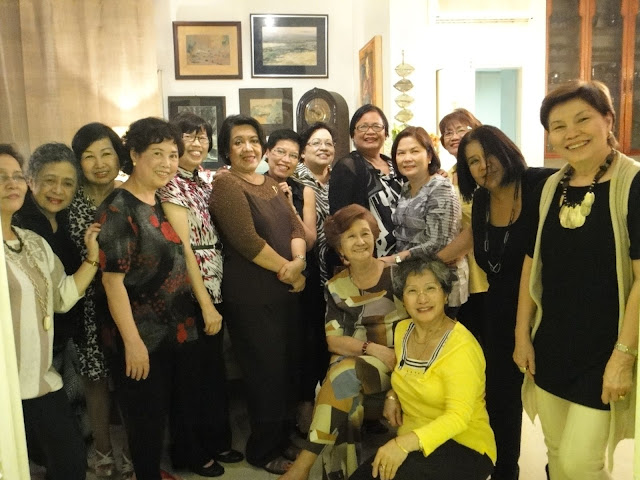
    Picture taken Jan 26, 2011 at RC's place Panay Ave, during the 50th anniversary of UP Prep class 61. Nilda passed away April 26, 2011. Nilda's breast cancer, from which she had about a six-year remission, has returned and has metastasized to her stomach.

    Perhaps you sent or spoke kind words
    As any friend could say;
    Perhaps you were not there at all
    Just thought of us that day.
    Whatever you did to console the heart
    We thank you so much, whatever the part……Nilda


    Auf Wiedersehen,Until we meet again! That is the meaning Of the familiar words, that men repeat At parting in the street. Ah yes, till then! but when death intervening Rends us asunder, with what ceaseless pain We wait for the Again! The friends who leave us do not feel the sorrow Of parting, as we feel it, who must stay Lamenting day by day, And knowing, when we wake upon the morrow, We shall not find in its accustomed place The one beloved face....HWL.....A Toast to Class61...

    I will cherise the memories of Melchor as a classmate, a neighbor, about 9 houses away in Vallejo and also a fellow  border town mate in Rizal, he from Pililla and me from Tanay.  It is sad to see him go at a fairly young age. I remember how we shared the same ride in our J.S. Senior Prom. We did not have any dates then, so my father fetched us on our way home. Although, we did not attend the same University, we pursued Engineering. In our careers as registered professional engineers, he worked with the City of San Francisco, as an inspector and me as an inspector with the State of California.

    I marvel at the almost parallel lives, But most of all, I will miss the jokes and laughter of a dear friend. ..ASC

      Melchor Capili, P.E. RIP


    Dr. Imelda O. Andres RIP
    The physical reflection,known as me: A fleeting thought of me may cross your mind And if you reach beyond the boundary line ,that holds your conscious thought,there I will be:For only in the passing do we grow to know,the meaning of the life that let us go; Love is the only thing that matters there or here.


    Early 1960:I remember the old beautiful architectural lines of the Manila Hotel, not the new monstrous addition as it is now.  it reinforces the fact that much of the loss of the quality of life in the metropolis owes to crass commercialism, slapdash development, and the regulated chaos that makes up for urban planning in the otherwise overly regulated and bureaucratized regime in the Philippines. I reflect the times in High School when we trek on to this site from Padre Faura, Rizal Hall to the US Embassy Canteen to buy our ice cream cone for 10 centavos. Pleasant memories too of my first exposure to teen age westerners on one to one basis in this Hotel at pool side parties. These songs jogs the memory lane.

    Golden @ Days Hotel

    by Renato View Album
    Play slideshow

    Golden @ Days/Balayan
    by Renato

    View Album
    Play slideshow

    by Renato

    View Album
    Play slideshow


    Dewey Blvd: The jetty potruding to Manila Bay is the future Cultural Center, on the other side of Dewey is the Manila Naval Station (MNS) where we lived from 1965 to 1966. the headquarters of the Philippine Navy was relegated to a small block of land south of the Manila Yacht Club. The original plan was to reclaim the site of the cultural center(CC) to replace the location of the MNS by the Central Bank. Imelda Marcos, saw this valuable real state and confiscated the plan for her project the now CC. The yacht club remained, the Navy base (MNS) was transferred to Fort Bonifacio.

    Pasay City, Aristocrat (Barbecue Plaza) Plaza, Dewey Blvd: So called, as barbecue stands abound from twilight to dawn. Scenes of fights between warring gangs during the evening and where ladies of the night sell their wares.

    Prominent movies of the day
    1

    Not to be outdone, my father indirectly thru his books, and literature, who most probably wanted me to follow his footsteps instilled in my mind, this speech from a well known soldier.

    "Duty, Honor, Country: Those three hallowed words reverently dictate what you ought to be, what you can be, what you will be. They are your rallying points: to build courage when courage seems to fail; to regain faith when there seems to be little cause for faith; to create hope when hope becomes forlorn.

    Unhappily, I possess neither that eloquence of diction, that poetry of imagination, nor that brilliance of metaphor to tell you all that they mean.

    The unbelievers will say they are but words, but a slogan, but a flamboyant phrase. Every pedant, every demagogue, every cynic, every hypocrite, every troublemaker, and I am sorry to say, some others of an entirely different character, will try to downgrade them even to the extent of mockery and ridicule. But these are some of the things they do. They build your basic character. They mold you for your future roles as the custodians of the nation's defense.

    They make you strong enough to know when you are weak, and brave enough to face yourself when you are afraid. They teach you to be proud and unbending in honest failure, but humble and gentle in success; not to substitute words for actions, not to seek the path of comfort, but to face the stress and spur of difficulty and challenge; to learn to stand up in the storm but to have compassion on those who fall; to master yourself before you seek to master others; to have a heart that is clean, a goal that is high; to learn to laugh, yet never forget how to weep; to reach into the future yet never neglect the past; to be serious yet never to take yourself too seriously; to be modest so that you will remember the simplicity of true greatness, the open mind of true wisdom, the meekness of true strength.

    They give you a temper of the will, a quality of the imagination, a vigor of the emotions, a freshness of the deep springs of life, a temperamental predominance of courage over timidity, of an appetite for adventure over love of ease. They create in your heart the sense of wonder, the unfailing hope of what next, and the joy and inspiration of life. They teach you in this way to be an officer and a gentleman."… Gen. Douglas McArthur

     Marcelo H. del Pilar y Gatmaitán


    Rizal Hall, University of the Philippines, September 1950. A photo album on the UP Carillon Tower before and after restoration (and with new bells)by the UP Alumni Association in time for the 2008 Centennial of the University of the Philippines.


      University of the Philippines Prep High School  Yearbook
       

      A great deal of important learning takes place outside the classroom. Traveling together making use of community resources, and exposing the students to a variety of new environments is all part of bringing the learning experience into the community setting.

        The University of the Philippines made this field trips available to the student body under the supervision of Mr. Rubio. I remember our trips to Bagiuo and Bicol by train. The later, I was not able to avail. students start the term with a trip to various High Schools, either to a resort, an American base, or towns in Luzon. School life is also enriched by additional field trips to such places important to the nation’s infrastructure, like dams, markets, military base and institutions like PMA.  Market place Bagiuo Right photo.


        Ms. Nympha Galang Nebrida May Her Soul RIP


        photo

        Benguet Road, Zigzag Kenyon Road. We came in contact with the Igorots shown above. The Igorots are in six ethno-linguistic groups, the Bontoc, Ibaloi, Isneg (or Apayao), Kalinga, and the Kankana-ey. Their habitat is the Northern mountains of Luzon, called the Mountain Province. We were introduced to the Tongali at Bagiuo High. It produces sound when air is blown into the instrument shown at left. The next video  was the old Baguio we saw back in 1957. It saddens me that the next generation will never see and experience what we did as children. I hope something is done to stop the devastation of Bagiuo City. Preserve what was once a beautiful and natural  Summer Place...

        Ms. Roma Clemente, one of my best teacher at UP. The song below “Love me Tender” was pure nostalgia. I missed the warmth and openness of the girls from Tanay during my Summer vacations and the beauty of its mountains.

        Ms. Nympha Galang My kind Math teacher

        Ms. Emma Pangilinan My Art Teacher


        The next morning we had tamales for breakfast hosted by Mrs. Roa who incidentally cut her finger preparing the tamales. Then lechon for lunch and a series of songs from Mrs. Pangilinan, in appreciation for hosting us, the location this time is hazy.The next billet is at Urdaneta High School below. The same as the last night, boys will be boys as  Mr. Toralba and Lazaro kept the peace.

        Burnham Park, where we rented roller skates, and then, shared one of these tricycles with a junior. I held both her hands, no names please, a boyish romantic encounter. Surely an unforgettable Chance Encounter for a boy of 13,  as she shifted towards me. We cuddled and continued to ride in the cool afternoon fog.

        Ambuklao Dam, newly constructed then, Photo of Bay Area Prep 61 and songs of 1957

        NESTOR RIVADELO
        MAY HIS SOUL
        REST IN PEACE


        MY FIRST CAR

        photo 


        image Pamintuan House at Angeles Pampanga. My Church in the town of my birth:Tanay, Built in 1778, the church was named after the Archbishop Ildefonso of Toledo, Spain, who was consecrated during the year 657 AD.

         ROAD TO BAGIUO ABOVE, THE KENNON ZIGZAG ROAD

        The Sixties Graduation from College and time to reflect the next path of life Top Hits of 1966 The Hippie Generation Vietnam War Protest Q...Memories of our field trip to Bagiuo in 1957. First stop was Angeles, Pampanga, where we toured Clark with Dr. Roa. I remember the doctor riding in a brand new 1957  yellow Chrysler with all the high fins typical of the cars of the late 50’s. The day was not over yet, a jam session in the moonlight at a basket ball court at the school grounds. The seniors and teachers alike did enjoy the ball hosted by the Pampanga High School. I remember the single Ms. Roma Clemente talking about her repertoire of dances and how she enjoyed it. Me, I stayed behind, as I do not dance yet, but was busy talking to local high school girls. I found out the beddings belong to them. Thinking this time, how UP Prep can reciprocate. Billets were in a gymnasium with rows of cots and mosquito nets. I do not know where the girls were, but the energy was ever flowing from the boys…as shoes were flying everywhere in the dark, landing safely at the mosquito nets. Above Pictures of the boys in a later field trip  (1960) to Bagiuo and Pampanga High School



        The next morning we had tamales for breakfast hosted by Mrs. Roa who incidentally cut her finger preparing the tamales. Then lechon for lunch and a series of songs from Mrs. Pangilinan, in appreciation for hosting us, the location this time is hazy.The next billet is at Urdaneta High School below. The same as the last night, boys will be boys as  Mr. Toralba and Lazaro kept the peace.



        Burnham Park above, where we rented roller skates, and then, shared one of these tricycles with a junior, held both her hands, no names please, a boyish romantic encounter. Surely an unforgettable Chance Encounter for a boy of 13,  as she shifted towards me. We cuddled and continued to ride in the cool afternoon fog.

        Ambuklao Dam, newly constructed then, Photo of Bay Area Prep 61 and songs of 1957


          photo

        Market place, Baguio, Pines Hotel where we stayed for two nights

        View of the Bagiuo Cathedral from my hotel room located adjacent to Pines Hotel.


        Ambuklao Dam, newly constructed then, Photo of Bay Area Prep 61, recent PI photo, and songs of 1957 below

         
        1

          photo

          The eagle above has the likeness of a Phoenix. The phoenix has long been presented as a symbol of rebirth, immortality, and renewal.  From the ashes, we were born during those extraordinary times, in the crucible of World War II, then in later years, the most changes and perhaps the last of the innocent generation. The years from 1943 to 1945 are considered to be the silent  (war babies) generation, between the so called hero and the baby boomer generations.  The war years, reflected my perception of this period that significantly impacted everybody. If not for the war and the turn of events, maybe we would not be even here. In truth, it is our trademark as war babies. How we and our parents survived the trials and tribulations of that era maybe a feat worthy to be written in the book of adventures.

          I have passed over 60 years of my life, but I still have vivid memories of the halls, and classrooms at Rizal Hall. I can not deny my deep feeling of warmth to this great school. Among the colleges that I have attended in the Philippines and in the USA during my academic life, my particular fondness is always with the University of the Philippines.  I and like every alumni of the U. P. Preparatory High School should be so proud of this University and the rich traditions that it represents…ASC


          When we were young, we were in a hurry to grow up
          The future a dream and now the reality
          These were icons of our mind as kids
          Now we know and we have learned

          Tomorrow, the tomorrow is uncertain
          With unknown script
          You don't know how
          Life can bring it
          Because everything is passing
          And what will happen tomorrow
          Nobody knows.

          Now that our wish came true
          To become adults, our life is complete
          Time is not enough for our dreams anymore
          Our childhood is gone…Greek

          U. P. Prep High School 1961 Rizal Hall...


            Wednesday, February 5, 2014

            Inside Queen Victoria's family


            The King versus the Kaiser: Royal rift that meant George V and Tsar Nicholas lined up against their German cousin in World War I

            • The Tsar and his royal cousin George V first met as children
            • Both found their cousin Kaiser Wilhelm II difficult - as did Edward VII
            • The Kaiser, meanwhile, had a troubled relationship with his English mother
            • The Danish mothers of George V and Tsar Nicholas loathed Germany
            • When war broke out in 1914, the cousins were pitted against each other

            The First World War saw millions of men separated from their families and sent to the front line but very few were pitted against their relations.

            For the royal family, however, World War I truly was a family affair.

            A new documentary has revealed how the roots of the Great War lay partly in the tangled web of Royal family relationships - in particular that of the British-hating Kaiser Wilhelm II of Germany and his cousins, George V and Tsar Nicholas of Russia.

            Best of enemies: Kaiser Wilhelm II and King Edward VII loathed each other despite being nephew and uncle

            Best of enemies: Kaiser Wilhelm II (L) and King Edward VII loathed each other despite being nephew and uncle

            Wilhelm, the eldest of the three and with a 'withered arm' - the result of a traumatic birth, was notoriously difficult and had a strained relationship with his English mother, Victoria - 'Vicky'.

            A BBC documentary, Royal Cousins at War, tells how the young Wilhelm's hatred of his parents, and all things Biritsh, in part brought about the beginning of the First World War.

            Vicky was only 17 when she married Prussia’s dashing Crown Prince Friedrich, known as Fritz, in 1858.

            It was a passionate love match that also fulfilled the dynastic dreams of her German father Prince Albert.

            After becoming pregnant only three months later, she underwent a traumatic breech delivery.

            A Caesarean – too dangerous at the time – was out of the question and the future Kaiser Wilhelm II had to be wrenched forcefully into the world. Three days later, a nursemaid noticed that his damaged left arm hung limply at his side - much to his mother's horror.

            'It cuts me to the heart when I see all other children with the use of all their limbs and that mine is denied that,' she wrote in an anguished letter to her mother.

            'The thought of him remaining a cripple haunts me. I long to have a child where everything is perfect about it just like everybody else.'

            Family feud: George V (pictured front centre) was no more keen on Kaiser Wilhelm than his father had been

            Family feud: George V (pictured front centre) was no more keen on Kaiser Wilhelm than his father had been

            Princess Victoria, mother of Kaiser Wilhelm, was the eldest daughter of Queen Victoria

            Tsarina Dagmar and Queen Alexandra were the Danish sisters who became mothers to the future Tsar Nicholas II and King George V

            Mothers: Princess Victoria, mother of Kaiser Wilhelm (L) and Tsarina Dagmar and Queen Alexandra (R)

            'This is the story of a proud mother who reacts really badly to her son's handicap,' explains Dr Karina Urbach of the University of London.

            'She tries to love him and tries to be a good mother but at the end of the day, she looks at him and sees a failure.'

            By contrast, Wilhelm's cousins, the future Tsar Nicholas and George V, were adored by their mothers, Alexandra and Dagmar - a pair of Danish royal sisters who married into two of Europe's most powerful dynasties.

            Theirs was a shared childhood with summers spent enjoying family breaks in Denmark at the home of their grandfather, Christian IX.

            Both were taught to mistrust the Prussians - later Germans - by their mothers, furious at Germany's annexation of Schleswig-Holstein, formerly a Danish possession, in 1864.

            Both were also in awe of their fathers, Edward VII and Tsar Alexander III, and became fast friends as a result.

            George V and Nicholas II (left and centre) first became friends as children

            The pair remained friends into adulthood

            Childhood: Tsar Nicholas II and George V met during family holidays in Denmark and remained close friends

            Firm friends: Tsar Nicholas II and King George V were cousins and close friends thanks to their mothers

            Firm friends: Tsar Nicholas II and King George V were cousins and close friends thanks to their mothers

            Loathing: Queen Alexandra, pictured with Edward VII and their son Albert, hated Germany after its conquest of parts of her native Denmark

            Alexandra, pictured with Edward VII and their son Albert, hated Germany after its conquest of parts of Denmark

            Peacemaker: Queen Victoria, pictured with Kaiser Wilhelm, his mother and Edward VII kept the family united

            Peacemaker: Queen Victoria, pictured with Kaiser Wilhelm, his mother and Edward VII kept the family united

            Wilhelm, however, proved less than popular with his British and Russian extended family; not least because of the treatment he meted out to his mother.

            As a teenager, he wrote strange  - almost sexually charged - letters to his mother Princess Victoria in which he described dreams of kissing her hands and caressing her.

            'Promise to do to me as I did in my dream to you. I love you so much,' the future German monarch wrote in one epistle.

            But when she replied speaking only of art and politics, the already tortured relationship continued to worsen.

            And when his father died in March 1888, his behaviour towards his mother was so shocking, it damaged relations with his uncle Edward VII forever.

            Upon becoming Kaiser, Wilhelm's first act was to have troops to surround the palace where his father died on the pretext of searching for for papers relating to his father's reign.

            But his ire was really directed at his mother, as her furious brother was only too well aware.

            Difficult: In contrast to his close relationship with George V, Nicholas II found Kaiser Wilhelm difficult

            At odds: In contrast to his close relationship with George V, Nicholas II found Kaiser Wilhelm difficult

            Wilhelm II during a summer break at Balmoral aged 4

            The Kaiser had an unhappy childhood and a tortured relationship with his mother

            Troubled: Kaiser Wilhelm (pictured aged 4 at Balmoral and later in Berlin) had an unhappy childhood

            Not close: Although related twice over, Tsar Nicholas II and Kaiser Wilhelm were not close friends

            Not close: Although related twice over, Tsar Nicholas II and Kaiser Wilhelm were not close friends

            In a letter written to his sister Victoria shortly after her husband's death, Edward wrote: 'His conduct towards you is simply revolting. His manners are not those of a gentleman.'

            But the family feuding came at a price: as relationships between the royal cousins waxed and waned, so did the relationships between their countries.

            Aware of the dangerous possibilities, one woman did attempt to broker peace: Queen Victoria, the family matriarch.

            Respected and listened to by all, even by her notoriously unstable grandson Wilhelm, the British Empress played peacemaker and ensured her family - and their respective nations - maintained good relationships.

            Family: Like George V, Nicholas II was devoted to his wife, a favourite grandchild of Queen Victoria

            Family: Like George V, Nicholas II was devoted to his wife, a favourite grandchild of Queen Victoria

            George V and Tsar Nicholas photographed together in 1913


            George V and Queen Mary at their coronation

            Tragedy: George V and Nicholas II remained close after their respective enthronements and until the end

            Wilhelm, in particular, adored her. But it couldn't last.

            In 1901, when it became clear she was dying, the Kaiser rushed to be with her.

            When she died, it was in his arms and he helped to lay out her body. At her funeral, he rode behind her casket alongside his uncle Edward VII.

            But with Victoria gone, peace between the Russian, British and German branches of the family dissipated and Europe edged closer to war: George V and Tsar Nicholas on one side, and their estranged cousin, Wilhelm, on the other.


            Inside Queen Victoria's family


            Intimate snaps of the monarch's husband and children among 200 images to appear in new exhibition

            • New exhibition includes 200 rare images from the Royal Archive
            • Queen Victoria amassed more than 20,000 photos during her life
            • Many are intimate family portraits, some featuring the Queen herself
            • Others document significant events such as the Crimean War

            From the invention of the telephone to the bicycle and even the steam ship, the Victorian period saw a mini revolution in the field of science and technology.

            But of all the new gadgets invented during her reign, it was the camera that delighted Queen Victoria the most.

            By the time she died in 1901, the UK's first modern monarch had amassed a huge collection of more than 20,000 images that included everything from favourite landscapes to early war photography and touching snaps of pets, friends and children.

            The Prince of Wales, the Princess Royal, Princess Alice, the Queen and<br />Prince Alfred, photographed by Roger Fenton in 1854

            Family portrait: Queen Victoria and five of her children in an intimate snap taken by Roger Fenton in 1854

            The Royal Family at home: An 1857 portrait of the Royal Family taken by Leonida Caldesi in 1857

            The Royal Family at home: An 1857 portrait of the Royal Family taken by Leonida Caldesi in 1857

            Now some of the rarely seen photos from her archive are to be included in a fascinating new exhibition that documents Queen Victoria's passion for photography and offers a glimpse of the Royals' family photo album. Although most of the photos remain in the Windsor Castle archive, 200 royal photos will appear at the Getty Center in Los Angeles, including many by early greats such as Roger Fenton,  Leonida Caldesi and William Edward Kilburn.

            Among them is a touching family portrait featuring Queen Victoria and five of her nine children; the Princess Royal, the Prince of Wales, Princess Alice, Princess Helena and Prince Alfred, taken in January 1852.

            More show the Queen relaxing at Balmoral, spending time with her husband, Prince Albert, or posing for formal portraits during her widowhood.

            Carefree childhood: Princesses Helena and Louise pictured playing in the garden by Roger Fenton in 1856

            Carefree childhood: Princesses Helena and Louise pictured playing in the garden by Roger Fenton in 1856

            The Queen and Prince Albert, May 11, 1854, photographed by Roger Fenton


            Queen Victoria's Diamond Jubilee portrait, taken by W. & D. Downey in July 1893

            A Queen remembered: Victoria with Prince Albert in 1841 (left) and the Diamond Jubilee portrait of 1893

            Not amused: Prince Arthur, Duke of Connaught seems less than thrilled to be starring in this Leonida Caldesi photo

            Not amused: Prince Arthur, Duke of Connaught seems less than thrilled to be starring in this Caldesi photo

            Other members of the Royal family also appear, among them Prince Arthur, Duke of Connaught, Queen Victoria's seventh child, and her consort, Prince Albert, both of whom appear in official photos.

            Another, more intimate snap shows Princesses Helena and Louise in matching tartan ensembles in the garden at Balmoral during a summer jaunt.

            But although family photos dominate, the Queen's interest in photography wasn't limited to pictures of her husband and children.

            Photos of some of the Royal palaces, among them Windsor Castle and Buckingham Palace, appear as do snaps documenting some of the most important events of the Victorian period.

            One, by William Henry Fox Talbot, shows Nelson's Column under construction in Trafalgar Square in 1844, while another chronicles the launch of the pioneering steamship, the Great Eastern, under the watchful eye of its designer Isambard Kingdom Brunel.

            Albert Hautecoeur's photo of the Round Tower at Windsor Castle

            Favourite palace: This photo, dating from the 1880s, shows the Round Tower at Windsor Castle

            Pioneer: This shot of Nelson's Column was taken by William Henry Fox Talbot, the inventor of the camera

            Pioneer: This shot of Nelson's Column was taken by William Henry Fox Talbot, the inventor of the camera

            Poignantly, another, snapped by court favourite Roger Fenton, shows the aftermath of the Charge of the Light Brigade during the Crimean War.

            Considered one of the first war photographers, Fenton travelled to the Crimea under the patronage of Prince Albert and returned with 350 images, among them harrowing shots showing the carnage created by the Siege of Sevastopol and the Battle of Balaclava.

            His famous photo, The Valley of Death, depicting the spot where the Light Brigade met its end is part of Victoria's collection, along with others documenting events such as the Indian Mutiny from around the Empire.

            Although a keen collector, Queen Victoria never took any photographs of her own, although her children all embraced the medium.

            But although she chose not to get involved in creating her own images, her penchant for collecting photos, as the new exhibition makes plain, helped preserve some of the most striking depictions of the Victorian period for future generations to enjoy.

            A Royal Passion: Queen Victoria and Photography opens at the Getty Center in Los Angeles on 4th February. See getty.edu for more information

            Innovation: Isambard Kingdom Brunel watching the launch of the Great Eastern, the first steamship, in 1857

            Innovation: Isambard Kingdom Brunel watching the launch of the steamship, Great Eastern, in 1857

            Valley of the Shadow of Death: The cannonball littered aftermath of the Charge of the Light Brigade, 1855

            Valley of the Shadow of Death: The cannonball littered aftermath of the Charge of the Light Brigade, 1855

            ROGER FENTON: THE WORLD'S FIRST WAR PHOTOGRAPHER

            From the Siege of Sevastopol to the Charge of the Light Brigade, Roger Fenton's striking shots taken in the Crimea are among the first war photographs ever taken.

            So who was the world's first war photographer? Born into a wealthy Lancashire family, Fenton was the fourth of seven children.

            He graduated with a degree in English, maths, Greek and Latin from Oxford University in 1840 and planned to study law before giving it up in favour of fine art.

            After stints in Paris, in the studio of Paul Delaroche and at the Louvre, he returned to London just in time for the Great Exhibition of 1851 where he discovered photography.

            Taught by early pioneer, Gustave Le Grey, within a year, Fenton was exhibiting his work nationwide and across Europe, and in 1853, helped found what would become the Royal Photographic Society under the patronage of Prince Albert.

            But it wasn't until war broke out in October 1853 between the British, Ottoman and French Empires on one side, and the Russian Empire on the other, that the photos that would define him in later years were taken.

            Encouraged by Prince Albert, he travelled to the Crimea, ostensibly to create photographs that would swing public opinion in favour of the unpopular war and counteract the critical reports being sent home by The Times' William Howard Russell.

            Based in the Crimea for just under 18 months, the 350 images he took are among the most enduring portraits of the Crimean War but did little to counter the negative public reaction.

            Much to his annoyance, when they went on sale following his return, the prints proved just as unpopular as the war itself with the paying public.

            His later career was spent travelling the length and breadth of the UK, creating stunning landscape photographs that proved far more commercially successful.

            In 1859, at his home in Potter's Bar in Hertfordshire, Fenton died after a week-long illness. He was just 50 years old.