A reflection of Our Family's Milestones and Challenges as life moves on....by ASC
1908 NewAmericanUniversity
Founding of our beloved University of the Philippines IN 1908
The University of the Philippines was established in 1908 as the American University of the Philippines
by an act of the First Philippine Legislature Act No. 1870, otherwise known as the University Charter, specified the function of the University, which is to provide advanced instruction in literature, philosophy, the sciences, and arts, and to give professional and technical training.
The University began with the College of Fine Arts, the College of Liberal Arts, and the College of Medicine and Surgery occupying buildings distributed along Padre Faura (Ermita district) and R. Hidalgo 1937 ATTY. EULALIO LEGASPI GRADUATED AND WAS NUMBER TWO IN THE BAR EXAM, NUMBER ONE WAS C. PALMA, BOTH OF THEM WERE CLASSMATES AT UP COLLEGE OF LAW AT PADRE FAURA AT TAFT AVENUE MANILA
1942 A gleam in your father's eyes were you
American victories in the Coral Sea and Midway Island U-Boat 505 WWII Photos PI Pearl Harbor December 7, 1941 Years of Occupation
Universityof the PhilippinesClosed inWWII During World War II, U.P. had to close most of its colleges except the Colleges of Medicine, Pharmacy, and Engineering. Meanwhile, the Japanese Imperial Army occupied two Diliman campus buildings: the College of Liberal Arts Building (now Benitez Hall) and the Colleges of Law and Business Administration Building (now Malcolm Hall). After the war, the new Diliman buildings were devastated. U.P. President Bienvenido Gonzales sought a grant of Php13 million from the US-Philippines War Damage Commission. A massive rehabilitation and construction effort was executed by the university during the post war years. For the first time, an extensive Diliman campus master plan and map were created in 1949. The map created what became visions for Diliman’s expansion projects. More buildings were to be built across the Diliman campus’ landscape: the University Library (Gonzalez Hall), the College of Engineering (Melchor Hall), the Women's Residence Hall (now Kamia Residence Hall), the Conservatory of Music (Abelardo Hall), the Administration Building (Quezon Hall), and the U.P. President's Residence . Most colleges and administration offices were temporarily housed in huts and shelters made of sawali and galvanized iron...Wikepedia
By June 1942, the Japanese controlled most of the Pacific area (Corregidor Photos), Malaya. Parts of Burma and Thailand, Indo-China, Hong Kong, the Dutch East Indies and the Philippines. However, the navies of America and Japan fought two epic battles in April and June that changed the course of World War II. Victories in the Coral Sea and at Midway Island shifted the advantage to the Allies in the Pacific.
The four-day Battle of the Coral Sea started when the Americans decoded Japanese invasion plans for Port Moresby, New Guinea, and Tulagi, in the Solomon Islands. America sent a naval force to stop the Japanese troops. The enemy ships never met each other, but from May 2 through May 6, both fleets attacked each other with waves of fighter planes and bombers. The Japanese lost 70 planes and its light carrier Shoho. The American losses included 66 planes and the aircraft carrier Lexington, a vital oceangoing carrier. Although victorious in terms of ship tonnage sunk, Japan lost too many fighter pilots to continue with the invasions. Thus its southward advances were halted.
A month later, American triumphed again at Midway. Once again they became aware of the Japanese plans, and lay in wait for the huge fleet of 86 warship sent by Japan to attack the tiny island in the Pacific. On June 3, the Japanese launched an attack on the two westernmost Aleutian islands, Kiska and Attu (the only American soil to be occupied by the Japanese during the war), in order to the divert the Americans' attention. The next day, a swarm of Japanese carrier-launched planes bombed Midway. The Americans responded with three consecutive air attacks on the Japanese, each a failure. But on June 5, the Americans bombing raid sank three Japanese aircraft carriers. His fleet devastated, Japanese admiral Yamamoto retreated west. The Japanese lost four aircraft carriers, a cruiser, 332 planes and 3500 lives; the Americans: one aircraft carrier, a destroyer, 147 planes and 307 lives.
Although the bloodiest battles of the Pacific were yet to come, the Japanese army never recovered from these defeats.
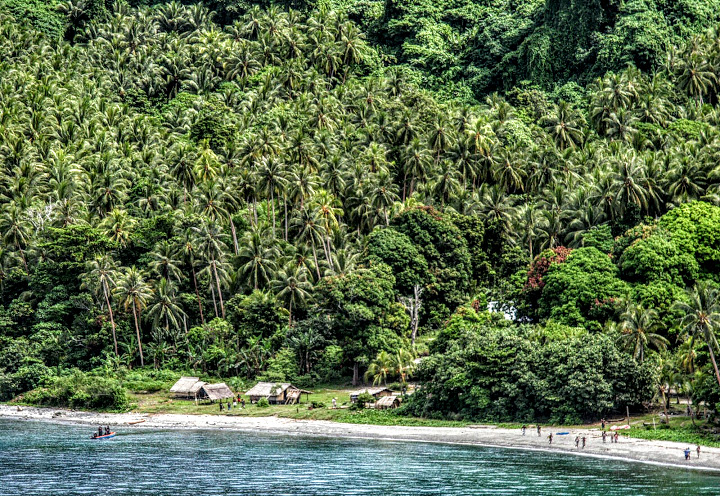
A photo of Guadalcanal from my travels in the Solomons in 2002 .........ASC Guadalcanal Battle Film
A photo of Guadalcanal from my travels in the Solomons in 2002 .........ASC
The Psalm of Life....HWL
Tell me not, in mournful numbers,
Life is but an empty dream! ?
For the soul is dead that slumbers,
And things are not what they seem.
Life is real! Life is earnest!
And the grave is not its goal;
Dust thou art, to dust returnest,
Was not spoken of the soul.
Not enjoyment, and not sorrow,
Is our destined end or way;
But to act, that each to-morrow
Find us farther than to-day.
Art is long, and Time is fleeting,
And our hearts, though stout and brave,
Still, like muffled drums, are beating
Funeral marches to the grave.
In the world's broad field of battle,
In the bivouac of Life,
Be not like dumb, driven cattle!
Be a hero in the strife!
Trust no Future, howe'er pleasant!
Let the dead Past bury its dead!
Act,--act in the living Present!
Heart within, and God o'erhead!
Lives of great men all remind us
We can make our lives sublime,
And, departing, leave behind us
Footprints on the sands of time;
Footprints, that perhaps another,
Sailing o'er life's solemn main,
A forlorn and shipwrecked brother,
Seeing, shall take heart again.
Let us, then, be up and doing,
With a heart for any fate;
Still achieving, still pursuing,
Learn to labor and to wait.
1940 A catholic San Miguel church like this one in Tanay, Rizal where Eulalio and Lucina Legaspi, our parents were married and us baptized hastily during World War II
Bataan Death March April 1942 TIO DAMASO LEGASPI (BROTHER OF EULALIO) SURVIVED THE DEATH MARCH BUT DIED IN PRISON OF DYSENTERY. In March of 1942 U.S General Douglas MacArthur and president Quezon fled the country. The cruelty of the Japanese military occupation of the Philippines was very brutal an aspect of samurai barbarism. The 76,000 starving and sick American and Filipino Defenders in Bataan surrendered to the Japanese on April 9,1942. The Japanese led their captives on a cruel and criminal Death March in which 7-10,000 died or were murdered before arriving at camp O'Donell 10 days later.
Bridge of Remagen, Germany 1944 Pictures Battle of Leyte Gulf October 1944
1944 Battle of Leyte Gulf & 10 / 44 Landings Normandy Invasion SongsLandings and Battle of Leyte Gulf

2,000 ships, 4,000 landing craft and 11,000 airplanes were involved in the largest seabo
rne invasion
ever. Allied troops crossed the choppy English Channel toward Normandy on June 6, 1944, on Operation Overlord: the regaining of northern Europe after four years of Nazi occupation.
First planned for 1942, the landing had been repeatedly postponed, this time with a delay of 24-hours caused by the worst storm in a quarter century. D-Day (a term referring to the first day of any military operation, but now associated with this 1944 invasion) started with paratroop raids before sunrise. Minesweepers (ships equipped for detecting and removing sea mines) cleared the waters while warships and bombers fiercely attacked enemy positions. Pre-manuafactured floating harbours were moved into place.
At 6.30am, American, British and Canadian troops under General Montgomery began swarming from landing craft onto beaches codenamed Utah, Omaha, Gold, Juno and Sword. After wading through the icy waves or charging towards land on amphibious
(able to travel on water and on land) tanks, the troops struggled past steel obstacles and barbed wired to recapture the first patches of French soil. At the end of the day, 155,000 men were onshore.
While preparations for the large-scale landing was too massive to conceal, the Germans did not put up a good defence because of disputes between Hitler, Field Marshall Erwin Rommel (overseer of military operations in France) and Runstedt (commander-in-chief in the west). They quarrelled over the probable invasion point and the best line of defence. When the attack came, Hitler took it as a diversionary tactic (an intentional distraction), and held back his forces for the "real" invasion.
Resistance was strong only initially at Omaha Beach, with 3,000 Americans casualties on the first day of fighting. The Allied invaders quickly spread out along 100 miles of coastline. However, Normandy's Nazi-occupied cities were harder to regain. Cherbourg held out for ten gruelling days, while Caen held out more than a month.
By mid-August, the Allies had broken out Normandy, and were sweeping across France. The Low Countries (the low-lying countries between Germany and France – the Netherlands, Belgium, and Luxembourg), and Germany itself, lay before them.
At the order of President Franklin D. Roosevelt, General MacArthur was evacuated from the Philippines in March 1942. Given command of Allied forces in the Southwest Pacific area, he directed the successful defense of southeastern New Guinea, and beginning later in 1942, the counteroffensive that ultimately swept the Japanese from the region, leading to his return to the Philippines with the October 1944 invasion of Leyte. Promoted to General of the Army shortly before the end of 1944, MacArthur subsequently oversaw the liberation of the rest of the Philippines. After Japan capitulated in August 1945 General MacArthur presided over the formal surrender ceremonies and, during the next five years, was responsible for demilitarizing the defeated nation and reforming its political and economic life. Eulalio F Legaspi The Godfather Albums Corner Here
The Early Formative Years 1956
The summer sun is sinking low;
Only the tree-tops redden and glow:
Only the weathercock on the spire
Of the neighboring church is a flame of fire;
All is in shadow below.
O beautiful, awful summer day,
What hast thou given, what taken away?
Life and death, and love and hate,
Homes made happy or desolate,
Hearts made sad or gay!
On the road of life one mile-stone more!
In the book of life one leaf turned o'er!
Like a red seal is the setting sun
On the good and the evil men have done,--
Naught can to-day restore!1945 Liberation freedom from the Japanese occupation. Most of us were born this year and also the previous year 1944
Atomic Bombs dropped on Hiroshima and Nagasaki
Place of Birth Old Manila Collection of War Pictures From Families in this era
Before sunrise, on August 6, 1945, an American B-29
bomber named Enola Gay set off from Tinian Island,
in the Marianas. Over Hiroshima, Japan, at 8.15am, it released one bomb. Instantly, 80,000 people died,
and most of Hiroshima was completely wiped out. President Harry S Truman told the American people:
"Sixteen hours ago an American airplane dropped one bomb on Hiroshima...
If they do not now accept our terms, they may expect a rain of ruin from the sky the likes of which has
never been seen on this earth"
Two days after Hiroshima, the Soviet Union declared war on Japan (as agreed at the February Yalta Conference between the big three – Churchill, Roosevelt and Stalin) and invaded Japanese-held Manchuria.
On August 10, America dropped a second atomic bomb, killing 40,000 in Nagasaki.
On August 14, Japan surrendered unconditionally. The following day, Emperor Hirohito addressed his nation over the radio for the first time. Explaining that the enemy "has begun to employ a new and most cruel bomb, the power of which to do damage is indeed incalculable," he announced Japan’s acceptance of Allied terms. Thus ended World War II.
On September 2, aboard the US battleship Missouri in Tokyo Bay, General MacArthur, the Allied Supreme Commander, received the surrender documents.
The bloodiest conflict in history ended with an even greater threat of inconceivable violence.
Humanity had obtained the power to destroy the entire world. Till today, debates continue, as to the necessity of using nuclear weapons against Japan.
Please read the arguments supporting and rejecting the bombing.
Pictures of Towns and Our places of Birth
Legislative Bldg. Manila 1945 Nagasaki Mushroom Cloud

Hiroshima 2002 at the Peace Park Ground Zero
1940
1941
1950
Somewhere in the Pacific Islands
Japanese POW in Manila 1945 Amazing American Hero Audie L. Murphy

Padre Faura, Part of Our Manila Campus UP Our Beloved High School Plaza Goiti Above
The Old Site of Our University of the Philippines Preparatory High School
1940
1950
European victory Intramuros Campus Now
For the European Axis powers, January 12 marked the start of their end, as the (Soviet) Red Army launched a vast attack in Poland.
Having been stretched thin along the 700-mile Eastern Front, losing in the
Balkans, and encircled in Lithuania, the German forces fell. The Soviets quickly took Warsaw (Poland) and Lódz. Hitler withdrew from
the Ardennes (a wooded plateau in the Champagne-Ardenne region of France; the site of intense fighting in World Wars I and II)
on the Western Front and rushed to Budapest in hopes of holding Hungary. By February, some Soviet divisions stood only 40 miles from
Berlin.
On March 23, the Allies attacked across the Rhine River. The Canadian 1st Army trudged through the Netherlands, the British 2nd drove
to the Baltic Sea, and US forces fanned out from Magdeburg to the Czech and Austrian border. Oradour-Sur Glane
Meanwhile, the Soviet pressed on, wreaking revengeful atrocities and driving hordes of refugees before them. By mid-April, they had taken Vienna, Danzig, and Königsberg. On April 25, they met with the Americans – with toasts and embraces – on the Elbe River. Remains of Krefeld and Brandenburg
Berlin fell on May 2, Axis forces in Italy and Austria surrendered the same day. On May 4, five days after Hitler’s suicide, his counterparts in Germany, Holland and Denmark followed suit. And on May 7, in Reims, France, the German High Command (represented by German General Alfred Jodl and Admiral Hans Friedeburg) surrended unconditionally. Only in Czechoslovakia did fighting go on for a few more days. On May 8, five years and eight months after it started, the war in Europe was officially over.
In the following weeks, the Allies arrested every Nazi official they could find on war-crimes charges. Hitler’s dream of a Thousand-Year Reich (empire) lasted only 12 years.
1946 Independence of the mother country and a gamble for a new government.
Pictures of The Philippines after the War 1946
Attempting to leave behind seven year carnage of the world war, ambassadors from 51 nations met in London on January 10, 1946, for the first session of the United Nations General Assembly. The UN was a body dedicated to preventing future global conflict, replacing the ineffective and discredited League of Nations.
The idea for a new international peace keeping organization was first raised in 1941 by President Roosevelt and Churchill, and was supported by the other Allies the following year, in the Declaration by United Nations. In the Moscow Declaration of 1943, China, Great Britain, the United States, and the Soviet Union affirmed the need to replace the League of Nations, and at the Dumbarton Oaks Conference in 1944, diplomats from those four countries drew up a proposal. A charter was drawn University of Santo Tomas
up by delegates from 50 nations and ratified (approved) later in the year. It called for a dominant body, a General Assembly of all members, as well as a "Security Council", composed of eleven members (five of them – China, France, Britain, the United States, and the USSR - permanent). The Security Council alone had authority to intervene in international disputes, only after full votes of support by its permanent members.
The Secretariat, led by the secretary general (the first was Norwegian statesman Trygve Lie, foreign minister of Norway’s wartime government-in-exile), carries out the UN’s businesses. At the invitation of the US Congress, the UN located permanently in New York City. John D. Rockefeller, Jr., using his family’s inexhaustible fortune, donated prime Manhattan real estates along the East River. By 1952, the main headquarters buildings were completed on the international land (owned by no country). Pictures of Corregidor below.
Spock's Baby books Pictures of Manila Past and Present
Published:
The Common Sense Book of Baby and Child Care by pediatrician Benjamin Spock. By 1990, his manual was in its sixth edition and had sold 40 million copies in 36 languages, making the doctor one of the most-read American author ever.

1949 Huk rebellion, muslim uprising in the South Kamlon era
Mao Establishes People’s Republic
On January 21, 1949, Chiang Kai-shek’s resigned as president of China’s Nationalist government after his armies were defeated by the Communists when America stopped its aid. Ten days later, Mao Zedong’s Communist forces entered Beijing. By late autumn, the Chinese Communist Party occupied all the major Chinese cities, including Nanjing, the Nationalist capital. The Communists had won the civil war. On October 1, 1949, Mao announced the birth of the People’s Republic of China from the Gate of Heavenly Peace, the entrance to Beijing’s ancient imperial palace. He would be Chairman, Zhu De, military commander of all Communist forces, would be vice-chairman; Zhou Enlai, leading diplomat, would be premier and foreign minister.
Mao Zedong, the son of peasants, imagined a China run by the common people. His government promised free thought, speech, and religion, and equal rights for women. China was to be modelled after the USSR, built on socialized agriculture and state-run heavy industry. The USSR and other Soviet-bloc states immediately recognized the People’s Republic of China; neighbouring Burma and India and many other European countries followed within a few months, including Great Britain (but Mao rejected British recognition). The United States withheld diplomatic recognition, remaining loyal instead to Chiang Kai-shek, who fled to Taiwan to re-establish his Nationalist government.
Domestic policies did not run smoothly. As many as a million people were killed in the violent clashes between landlords and tenants that came with widespread land reforms. Meanwhile, the Chinese Communist Party was unpopular with the common people because it treated wealthy peasants better as it could not afford to alienate them. Quickly, Mao’s vision of a China run by the common people, became a China run by Mao.
In May of 1949, Mrs. Aurora Aragon Quezon a well-loved figure in the Philippines, the wife of the late Manuel Quezon, first President of the Philippines, was assassinated. She had long led a quiet, austere life devoted to charities and the rearing of her family. When the President died, she turned down the pension awarded her by the government, so that the money might be used for needier war widows and orphans. Even the Communist-led Hukbalahaps, who spread terror through the hills of Central Luzon, could find no word to say against Doña Aurora.

With her eldest daughter Maria Aurora ("Baby"), her younger daughter's husband and a handful of Filipino officials, Mrs. Quezon traveled by car from Manila to Baler, where she was to dedicate a memorial to her husband. Riding in a station wagon with her relatives and Major General Rafael Jalandoni, she led the party through the mountains northeast of Manila where the Huks are thickest. All her companions felt that there was no danger involved where Mrs. Quezon was concerned.
Then without warning, in a rocky cleft 88 airline miles northeast of Manila, the mountains were rent with the splat of machine-gun fire. Mayor Ponciano Bernardo of Quezon City stood up to shout, "Doña Aurora is in our party!" A slug from a Garand rifle brought him down.
More bullets riddled the station wagon. General Jalandoni threw himself in front of Mrs. Quezon and drew his revolver. A rifle butt slammed into his cheek, he fell unconscious. Before the police escort riding behind could open fire effectively, the attackers had seized what valuables they could and melted into the green hills. Soon afterward, General Jalandoni came to. About him were twelve dead, including the Philippines' first lady, her daughter, and her son-in-law, whose pregnant wife had stayed at home.
"I can't believe the Huks did it," said shocked President Elpidio Quirino, when he heard the news. "Mrs. Quezon was loved too much." Police assured Quirino that the Huks were responsible, all right. At Doña Aurora's funeral, the sobbing President placed a single flower on the grave of the widow. Then, over the Philippine radio, he called for an all-out campaign against the terrorists.
As a nine-day period of national mourning was declared, Filipino planes and government troops combed the mountains in search of the slayers. From his hideout, Huk Leader Luis Taruc issued a statement which would scarcely comfort or reassure the bereaved islanders. If, he said, his own investigation revealed "a breach of Hukbalahap iron discipline," punishment of the guilty party would be carried out swiftly.
1940
1950
education in the 50's top hits
The Korean War Begins The War Movie
Before dawn on June 25, 1950, the Soviet-equipped North Korean People’s Army into the Republic of South Korea. Two days later, after an emergency session of the Security Council (which the Soviets voluntarily did not attend), the United Nations invited its members to help South Korea against the invasion. President Truman immediately involved US air and naval forces, and added ground troops a few days later.
The Korean War was the first ever "police action" to taken by the UN, however more importantly, it was a symbol of the Cold War: In a remote land, the forces of democracy (from US) would come up against the Communists (Soviet Union, with Communist China support). Despite the fact that there was never a formal declaration of war, the conflict escalated to a point where 20 nations were involved.
In the first weeks of war, the North Korean People’s Army steamrolled across South Korea, capturing the country’s port city, Inchon, and its capital, Seoul. They put pressure on the UN beachhead (an area in hostile territory that has been occupied and is held for further troops and supplies) at Pusan, on the southeastern tip of the Korean Peninsula.
Then General Douglas MacArthur, the 70-year-old World War II hero, was named supreme commander of UN forces. He executed a dramatic landing at Inchon, and recaptured Seoul in September. The United States launched a new goal: the unification of Korea. In October, UN troops invaded North Korea, took its capital, Pyongyang, and rolled on towards the Chinese border. Espirito Santo Church in my Parochial School ESPS
The move spurred on China to send in 180,000 of its own troops. A fresh Communist attack regained Pyongyang in December. By the end of the year, North Korea was again fully under Communist control. Then, on December 31, the Chinese, vowing to "liberate Korea" moved on Seoul. By January 15, they had recaptured it.
Before dawn on June 25, 1950, the Soviet-equipped North Korean People’s Army into the Republic of South Korea. Two days later, after an
emergency session of the Security Council (which the Soviets voluntarily did not attend), the United Nations invited its members to help South Korea against the invasion. President Truman immediately involved US air and naval forces, and added ground troops a few days later.
The Korean War was the first ever "police action" to taken by the UN, however more importantly, it was a symbol of the Cold War: In a remote land, the forces of democracy (from US) would come up against the Communists (Soviet Union, with Communist China support). Despite the fact that there was never a formal declaration of war, the conflict escalated to a point where 20 nations were involved.
In the first weeks of war, the North Korean People’s Army steamrolled across South Korea, capturing the country’s port city, Inchon, and its capital, Seoul. They put pressure on the UN beachhead (an area in hostile territory that has been occupied and is held for further troops and supplies) at Pusan, on the southeastern tip of the Korean Peninsula.
Then General Douglas MacArthur, the 70-year-old World War II hero, was named supreme commander of UN forces. He executed a dramatic landing at Inchon, and recaptured Seoul in September. The United States launched a new goal: the unification of Korea. In October, UN troops invaded North Korea, took its capital, Pyongyang,and rolled on towards the Chinese border.
Go:1950
The Early Formative Years 1956
Legaspi Family Albums Debut of Marissa 192

1951 Life in Manila in the 50's were easier, the exhange rate was 2 pesos to one $; Top Hit songs from 1951 to 1954
First-generation computers had shown their usefulness during World War II, largely for solving codes, and leading engineers recognized the enormous potential of devices that could solve problems in milliseconds. By 1951, all-electronic computers (using vacuum tubes instead of moving parts) started to be used for civilian purposes in the United States and Britain, marking the dawn of the information age.
In 1946, two scientists, John Eckert and John Mauchly, while at the University of Pennsylvania, built the first all-purpose, all-electronic digital computer, for the US army. Disappointed by the slow pace and conflicting goals of academic research, they left the University shortly after, to form Eckert-Mauchly Computing Corporation. Brilliant at engineering but poor at business, they were on the brink of bankruptcy until 1950 , when Remington Rand, a major office-supply company, bought their business. The following year, the engineers delivered the UNIVAC (Universal Automatic Computer) to the US Census Bureau in Philadelphia.
In our elementary grades and first Holy Communion
UNIVAC was by far the best computer built so far. It used magnetic tape instead of bulky punch cards for information input and output, and was capable of reading 7,200 digits per second and of handling alphabets and numbers with ease. Its success stirred the business-machine industry (still dependent on mechanical devices such as typewriters), forcing sales leader IBM (International Business Machines) to revise its low opinion of electronic computing. Determined to protect its market, IBM set to work on its own series of "thinking" machines. Over the next three decades, as such computers spread gradually across the planet, most would be labeled IBM.
1953 Magsaysay wins over Quirino in Presidential elections; Songs of 53
Mount Everest Conquered
Mt. Pico de loro in the Philippines
On May 29, 1953, New Zealand mountaineer Edmund Hillary and Nepalese Sherpa guide Tenzing Norgay reached the summit of Mount Everest, the highest point on earth at 29,028 feet. Upon reaching the peak, the climbers, part of a British expedition, shook hands and unrolled a string of flags (United Nations, British, Nepalese, Indian). They stayed in the subzero (below zero degrees) cold for 15 minutes, breathing from their oxygen tanks, then began the descent. In England, Hillary and the leader of the expedition, John Hunt were promptly knighted. Hillary later returned to the Himalayas and helped build schools, hospital, and airfields for the Sherpa people, without whom he could have never made it to the top.
On April 25, 1953, Francis Crick and James D Watson, scientists at Cambridge University’s Cavendish
Laboratories, published an article in the British scientific journal, Nature, defining the structure of deoxyribonucleic acid (DNA). They presented it as a double helix – two intertwined , spiraling strands of polymers (large molecules made up of a linked series of small molecules). When DNA separates into individual strands, each strand becomes the foundation on which another identical one is built. Each new molecule contains the same genetic information as the original strand. Thus are genes and eventually, chromosomes (DNA) duplicated, and genetic traits reproduced.
Go:1960
The undeclared Korean War ended in 1953, after three years of fighting between North Korean and Chinese Communists against the United Nations forces (mainly South Korean and American). An estimated four million people died, including nearly a million Chinese, 54,000 Americans, several thousand other UN troops and some two millions North and South Koreans. However, very little territory was actually gained or lost between the two sides.
Peace talks had begun in the spring of 1951, but had been obstructed by two main issues: where to draw the truce-line between the two Koreas, and what to do with the prisoners of war. It was only in June 1953, that the two groups neared an agreement (at the UN’s border, and a neutral commission to judge in the case of prisoners unwilling to be repatriated (sent back to their homeland against their wills, like refugees). On July 27, the agreement was signed, ending the war.
THE YEAR WAS 1954
A Vaccine for Polio Hit songs of 1955
St. Theresa's College, (also called STC), Philippines, is a Catholic private school for girls run by the Missionary Sisters of the "Immaculati Cordis Mariae" or Immaculate Heart of Mary (ICM).
St. Theresa’s College, Quezon City (STCQC) offers programs from the preparatory level through the elementary and secondary levels. As an ICM school, its whole educational program draws inspiration from Mother Marie Louise De Meester, Foundress of ICM.
Its students are called “Theresians”, from the name of its patroness St. Teresa of Avila. Heading the school for the ICM sisters is Sr. Josefina Nebres, the school directress.
Mother Marie Louise De Meester (born on April 8, 1857 in Roesalare, West Flanders, Belgium) and her novices arrived on the shores of Tagudin, Ilocos Sur on June 21, 1910. Tagudin became the foundation of the ICM missionary work throughout the Philippines which gave birth to ranking institutions of learning in the country including the different campuses of St. Theresa's College.
Mother Marie Louise De Meester founded St. Theresa's College, Manila (STCM) in 1915 at the expressed invitation of the Most Reverend Jeremiah James Harty, the first American Archbishop of Manila. When World War II wrought havoc on the St. Theresa's College in San Marcelino, Manila, leaving it in ruins, little hope was left for the rebuilding of its physical structure. While St. Theresa's College Manila was re-built, re-opened and continued to be run by the Belgian Sisters until 1980 (over a two-year phase out; STCM property was eventually sold to Adamson University), steps were taken after WWII to look for a property which would be larger than the San Marcelino Compound.
In January 1946, a contract was signed for the purchase of a property consisting of five (5) blocks, in Sta. Mesa Heights, Quezon City. The US Army, which previously occupied the place, left a rudimentary make-shift building, later to be utilized temporarily for the classrooms of St. Theresa's College, Quezon City, and for the quarters of the Sisters.
January 7, 1947, marked the establishment of STCQC. However, the school was officially opened only in June 1947.
The institution, from the first days of its foundation, had consistently stressed at all levels of instruction, the wholistic formation of the Theresian into a committed Christian upholding the highest standards of excellence, leadership, character and nationhood.
St. Theresa's College, Quezon City is a member of the Catholic Education Association of the Philippines (CEAP), and the Philippine Accrediting Association of Schools, Colleges, and Universities (PAASCU) and avails itself of the services of the institutions and groups working for the reorientation of education in the Philippines. It is a Catholic institution of learning and development for young women, owned and administered by the Missionary Sisters of the Immaculate Heart of Mary (ICM Sisters). St. Theresa's College provides its students from the preparatory level through elementary and secondary school a dynamic program of basic education which stresses both training for academic proficiency and on-going formation within life situations.
As an ICM school, our structures, content and processes of learning are imbued with a missionary spirit, which is the living legacy of Mother Marie Louise De Meester. Likewise, the spirit of St. Theresa of Avila, seeker of truth and woman reformer, permeates our educational program.
Thus, our school is committed:
To develop and enhance the gifts and potentials of every student through a formation that is both holistic and steeped in the Gospel values;
To promote a transformative education, where leadership is exercised in service with a preferential option for the poor and by working for justice;
To foster right and life-giving relationships with God, with nature, with other persons, and with oneself;
To confront unjust, inhuman and life-threatening structures and practices prevailing in society in solidarity with various sectors of the larger community and to work together for social transformation by empowering wo/men and by protecting the integrity of the earth;
To seek and develop an alternative style which espouses simplicity and assures sustainable sufficiency for all;
To promote a culture of peace.
All of us - administration, personnel, students, parents, alumnae, and ICM Sisters - are partners in mission. Let us walk together with Jesus Christ as our light. Let us make our school, our homes, the Philippines, and the world oases of life, love, and peace. Let our light shine and be a blessing!
The original certificate of St. Theresa's College, Q.C. was issued on February 19, 1947. STC campuses
St. Theresa's College Manila (STCM), 920 San Marcelino Street, Manila (1915-1980 phased out)
St. Theresa's College Cebu (STC Cebu), Don Ramon Aboitiz Street, Cebu City (1933-present)
St. Theresa's College Quezon City (STCQC), 116 D. Tuazon Avenue, Quezon City (1947-present)
St. Theresa's College Baguio City (STC Baguio), Navy Road, Baguio City (1953-1973 phased out)
The school’s high standard curriculum was designed for secondary school graduates with the aptitudes and intellectual talents for university level education. The faculty was carefully selected for these advanced subjects.
Only by passing a battery of rigorous examinations could a student get in, and once accepted, he or she had to hurdle to pass each of the four tough years of the highest standard of education ever given to high school students in the Philippines before one could graduate. Through the years, since the founding of St. Theresa's College in San Marcelino in 1915-followed by three other schools in Cebu 1937, in Quezon City 1947 and in Baguio 1953-the Belgian-run STC has produced outstanding women who have proven successful in their professions and who have given back to society. The Theresians are who they are today because of education founded on knowledge and skill, simplicity, religion and practical application. And if they have stood out, it is but a fulfillment of their rallying cry, "Let your light shine."
A Vaccine for Polio
On 26 April 1954, the largest clinical trial in medical history was launched in New York City by the National Foundation for Infant Paralysis (NFIP). It was the testing of a vaccine against polio, which was discovered by Jonas Edward Salk.Salk had worked on the vaccine for several years, employing methods developed by John Enders at Havard University. The vaccine is actually the polio virus itself, but treated to make it unable to pass on the disease, while allowing the body to build up immunity against polio.
Salk, however, was apprehensive about the mass trial. A similar trial in 1935, gave healthy children polio, killing six of them. The virologist had tested the vaccine on some children, including his three sons, but was still unsure about the vaccine. "When you inoculate children with a polio vaccine, you don’t sleep well for two or three months."
However, the NFIP, founded by US President Franklin Roosevelt (himself paralysed by polio), went ahead with vaccinating 1.8 million children across 44 states, at a cost of $7.5 million. This marked the end for a disease that affected tens of thousands of children every year.
Members Listing Highschool 29 - 49 and College 34 - 39
Members Listing Highschool 50 - 59 - College 40 - 59Members Listing Highschool 60 - 69 and College 60 - 68
Members Listing Highschool 70 - Highschool 80
1959 Elementary Graduation
and the arduous passage to Be A
THERESIAN STC QUEZON CITY
USSR launch Sputnik 1957 Ramon Magsaysay 3rd president of PI killed in airplane crash Memory Lane Music Photos
On March 16, 1957 Magsaysay left Manila
for Cebu City where he spoke at three educational institutions. That same night, at about 1 a.m., he boarded the presidential plane "Mt. Pinatubo", a C-47, heading back to Manila. In the early morning hours of March 17, his plane was reported missing. It was late in the afternoon that day that newspapers reported that the airplane had crashed on Mt. Manunggal in Cebu, and 26 of the 27 passengers and crew aboard were killed, only newspaperman Néstor Mata survived. Vice President Carlos P. García, who was on an official visit to Australia at the time, assumed the presidency to serve out the last eight months of Magsaysay's term.
On 4 October 1957, the Russians won the first round of the epic "space race" between the Soviet Union and the United States by successfully launching a satellite into orbit around the Earth. The spherical, 56 centimetre (22 inch) Sputnik was fired into space using rockets developed from wartime V2 rockets used by the Nazis.
The V2 rockets had been developed for the purpose of carrying hydrogen-bombs great distances around the world. Sergei Korolyev, the project's chief designer was serving a life sentence for treason at Kolyma Gulag when the World War II ended and Stalin made him responsible for locating German rocket engineers in the Soviet zone to exploit their skills. When Khrushkev needed an image boosting propaganda coup to convince the USA that the USSR had developed intercontinental missiles, Korolyev was put in charge of designing a satellite.
Although given only six weeks to design Sputnik, the project was a success. Passing over Asia, Europe and the US, a message of triumph was transmitted from a battery-powered radio contained in the satellite. But before the year was out, history was made again. On November 3, a second satellite, Sputnik II was fired into space carrying the first animal in space -- a female dog named Laika. Laika was launched into orbit for the purpose of studying the effects of space travel on animals in preparation of sending humans.
The space race is on between the US and USSR.
Passed the selection process 40 % quit or flunked in the upper classes mostly in the
junior years; Changes in Math Subjects ie.
Solid Geometry add Oriental To US History
1959 Passed
the Gauntlet & on to 3rd Year, Excellent Faculty; MUSIC & PEd. forced upon us on Saturdays
On New Year's Day 1959, les barbudos (the bearded ones) led by their firey leader, Fidel Castro, took Havana, ousting the government of the dictator Fulgencio Batista, who fled the day before, taking with him most of the national treasury. Under Batista -- dominant since 1933 and outright dictator from 1952 -- Cuba, the world's largest producer of sugarcane, had suffered brutal repression and gross exploitation.
The corrupt dictator crushed any opposition by either jailing or having them killed, siphoned away some $40 million from state coffers and sold the country to foreign capitalists. At the time of the revolution, Americans had a 40 percent stake in Cuban sugar, a 9 percent share in mineral wealth, and a whopping 80 percent interest in controlled public utilities as well as other interests in the oil refineries, banking and tourism industries. Investors made huge profits but little of the wealth trickled back to the six million island inhabitants.
In 1953, a young lawyer named Fidel Castro led a failed uprising and was jailed, where he famously announced, "History will absolve me." Cuban's admired his mettle and his campaign against Batista drew support from a broad cross-section of the population, including landless peasants, urban workers and middle-class businessmen.
When Castro was freed in a 1955 amnesty, he went to Mexico and plotted Batista's overthrow, finally returning in 1956 to wage a guerrilla war. The slogan of his insurrection was "Cuba for Cubans". Assuming total power in 1959, Castro began aggressive agrarian and industrial reform measures, eventually expropriating a billion dollars worth of American properties.
Opponents began to suspect that Castro was communist. In February 1960, Castro signed a five-million ton sugar deal with the Soviet Union; later, when U.S. refineries in Cuba refused Soviet oil, Castro seized them. U.S. President Eisenhower responded with trade embargoes and a year later severed diplomatic relations. Inevitably, Castro moved closer to the Soviets and after the Bay of Pigs Invasion, the (embarrassing) failed invasion attempt by the U.S., declared that his revolution was indeed communist: the first in the Western Hemisphere.
by Henry W. Longfellow
Often I think of the beautiful town
That is seated by the sea;
Often in thought go up and down
The pleasant streets of that dear old town,
And my youth comes back to me.
And a verse of an Island song
Is haunting my memory still:
"A boy's will is the wind's will,
And the thoughts of youth are long, long thoughts."

The exciting 60's brought the most change and maybe the last innocent decade of our generation
1963 Class 63 Graduation At The Crossroads Time in the 60's Twopaths, Music at STC or a degree in BSBA Plan B won
The Berlin Wall is constructed Inside San Marcelino More of the Walled City Around STC
On August 13 1961, a grim convoy of tanks and troops wound through eastern Berlin before dawn. By sunrise, East German soldiers had stretched barbed wire across the city, cutting off the Communist sector from the capitalist. A network of concrete walls and electrified fences, guarded by armed men, dogs and minefields soon replaced the wire. Churchill's Iron Curtain metaphor had become a reality.
The 30-mile barrier was built ostensibly to keep out saboteurs and subversives but the Berlin Wall was in fact meant to keep East Germans in. Since 1949, 2.5 million had fled the economic hardships and political repression of Germany's Communist half, creating labour shortages and a "brain drain" of professionals and skilled workers. West Berlin, an island of democracy and capitalism in the midst of East Germany was the principal escape route. In addition, since thousands of eastern-Berliners worked in western Berlin before the wall was built, defectors could easily evade detection.
Through the years, the Soviets had periodically demanded that all Berlin be made a "free city" with both Western and Soviet troops withdrawn. But the Western powers, fearing a total communist take-over, had refused.
In June 1961, Khrushchev threatened to use nuclear weapons if the "Berlin question" was not swiftly resolved. When heightening tension accelerated the stampede of illegal emigrants (30,000 East Germans defected in July), the Communist authorities decided to stem the flow by force. The wall was their solution. Henceforth travel eastward was subject to strict restrictions while travel westward was banned.
Though crowds of angry West Berliners confronted the wall builders (only to be dispersed with tear gas and water cannons), and the United States sent in extra troops as a symbolic gesture, fear of retaliation ruled out more forceful measures. A trade embargo against East Berlin was considered but the Communists vowed to blockade West Berlin in response. Eventually, the East Germans encircled all of West Berlin with a fence topped by watchtowers. Travel restrictions for Westerners eased somewhat in the 1980s, but the wall and all it stood for remained intact for nearly three decades.
The woods are lovely, dark, and deep,
But I have promises to keep,
And miles to go before I sleep,
And miles to go before I sleep
Our Love of the Mountains and open Space
I will lift up mine eyes to the hills
From whence cometh my help
My help cometh from the Lord
Who hath made heaven and earth
1962 The Cuban Missile Crisis The Rudimentary Stage of Environmental Awareness Movement; Top Hits of 1962
Rachel Carson’s Silent Spring changes public perception
In 1962, Rachel Carson published a book which would soon challenge the public’s trust in scientific "marvels" such as pesticides and began the tide of concern for the environment which presently swept through the developed world. In Silent Spring, Rachel Carson shocked readers by making them visualize a place where no birds sang, hen’s eggs never hatched and apple trees bore no fruit – a place where cattle died mysteriously in the fields and children fell dead on the playground. Then she told them the place was real, if only in composite: Its description was drawn from real-life incidents that actually happened in the United States and
in other countries where artificial pesticides were being used. The Beatles Fashion Trend
Silent Spring alerted millions to the dangers of the toxic substances that in recent decades had become commonplace on farms and in households around the world. Agents of agribusiness and the chemical industry, thrown off by Carson’s fine prose style, attacked her scientific credentials. In fact, she was a respected marine biologist who’d carefully traced the destructive effects of two major pesticide groups, chlorinated hydrocarbons and organic phosphates, as they worked their way though the ecosystem.
But Carson did not want a total ban but argued instead for controlled use. She revealed that DDT (one of the most popular poisons) could now be found at the ice caps. She explained how insecticides residue on treated produce is stored in human tissues and passed from mother to unborn child. And she helped launch the modern environmental movement.
A Kennedy administration study confirmed study confirmed Carson’s report and in 1972, the U.S. Environmental Protection Agency banned DDT. Many other countries followed suit. Even so, the use of pesticides on food continued to grow, reaching nearly a billion pounds annually in the United States alone by the 1980s.
1963
HIGH SCHOOL GRAD major BA, MUSIC LESSONS
heavy in extra curricular activities & GLEE CLUB
JFK Assassinated Songs we Studied with
The world was horror-struck on 22 November 1963 when John F Kennedy, the charismatic young president, became the third U.S. President to have been assassinated. At 12:30pm, Friday, the President was travelling with his wife, Mrs Jacqueline Bouvier Kennedy and Texas governor John Connally in a black Lincoln convertible through the streets of Dallas. While Dallas resident Abraham Zapruder’s home-movie camera rolled, a hidden assassin shot President Kennedy in the head even as crowds of cheering, flag-waving people watched on.
The limousine sped off to Parkland Memorial hospital with the President slumped across the backseat with a blood-spattered Mrs Kennedy cradling him in her arms. JFK was pronounced dead 30 minutes later.
By 1:45pm, Dallas police had seized a suspect: Lee Harvey Oswald, a 24-year-old employee of the Texas School Book Depository, from whose sixth-floor window the shots were said to have been fired. Two days later, on Sunday, November 24, millions of Americans watched on television as Oswald was being transferred from the Dallas city jail to a county jail. Suddenly, a local night-club owner with a criminal record named Jack Ruby stepped out of a small crowd and shot Oswald at point-blank range in the stomach with a .35-calibre revolver. Oswald died within minutes.
The alleged assassin’s bizarre, mob-style "silencing" and other murky details of the assassination (including various interpretations of Zapruder’s film, the only film record of the event) gave rise, almost instantly, to a host of theories about who was responsible. (The official explanation, the Warren report of 1964, did little to assuage the nation’s bewilderment.) Indeed, JFK’s assassination grew into a kind of national obsession, spawning numerous conspiracy Alpha Phi Omega Brothers Delta Chapter Philippines theories. "Where were you when Kennedy was shot?" became the question by which a generation of bereft Americans identified itself. By the time Lyndon Johnson was sworn in as the 36th president aboard Air Force One in Dallas three hours after the shooting, the Kennedy legend had grown to epic proportions, hiding harsh realities including the nation’s violent division over civil rights and its increasing entanglement in Vietnam.
1966
Muse APORecuerdo of old Manila, the path to San Marcelino Manila campus & Quezon City
Surgeon General warns against cigarette smoking 64 Songs
General Douglas MacArthur, U.S. Army, (1880-1964)
Cigarettes lost their glamour in 1964, the year the U.S. government issued its landmark report on smoking. Confirming private studies, the Surgeon General’s findings, compiled by ten independent researchers, implied that smoking constituted a major cause of lung cancer and heart disease. Less than two years after the report’s release, the U.S. Congress ordered that warnings against the dangers of smoking appear on all cigarette packages sold domestically. Great Britain soon followed suit; by 1972, West Germany, the United States and Canada had banned television advertising of cigarettes. Many European countries also began imposing steep taxes on cigarettes.
Since the 1950s, scientists had already begun linking tobacco to disease. By then, lung cancer, previously unheard of at the turn of the century, had become a big killer. Its increased incidence corresponded roughly to the rise of smoking’s popularity. Which boomed during World War I, when tobacco manufacturers supplied troops with free cigarettes. During World War II, the popularity of smoking again received a similar boost, when doctors even encouraged smoking as a way to calm nerves. As the hazards emerged, tobacco companies, which had once recommended the beneficial properties of their product, began making defensive claims. As early as 1949, an advertising campaign for Camel, a popular brand, featured anonymous "noted throat specialists" unable to document a single case of Camel-caused throat irritation.
In the United Sates, at least, the Surgeon General’s warning was effective as the numbers of smokers plummeted. In the mid-1960s, over 40 percent of American adults smoked. By the nineties, the proportion had decreased to under 25 percent.
1965 This was the start of the diaspora to "our chosen destiny" to the USA; Top hits 65 Work in Private Sector
1965 Immigration Law Changed the Face of America My Choice Wheels Chosen Nation
President Lyndon B. Johnson (center) signs the sweeping immigration bill of 1965 into law at a ceremony on Liberty Island, Oct. 4, 1965. Sen. Edward Kennedy and his brother, Sen. Robert Kennedy, are seen at right. The Long View on Immigration
As a young politician, Sen. Edward Kennedy helped steer the 1965 immigration law through the Senate. He reflects on the politics that helped push the overhaul through then -- and on the current debate over immigration -- in an interview with NPR's Jennifer Ludden, exclusively on npr.org:May 9, 2006 Read the Q&A with Kennedy All Things Considered, May 9, 2006 · As Congress considers sweeping changes to immigration law, nearly all the debate has centered on the problem of illegal immigration. Little discussed are the many concerns of legal immigrants, the estimated 3 million to 4 million who are, as it's so often been put --"already standing in line."
The current system of legal immigration dates to 1965. It marked a radical break with previous policy and has led to profound demographic changes in America. But that's not how the law was seen when it was passed -- at the height of the civil rights movement, at a time when ideals of freedom, democracy and equality had seized the nation. Against this backdrop, the manner in which the United States decided which foreigners could and could not enter the country had become an increasing embarrassment.
The United States and the Vietnam War Selma March
The United States entered the Vietnam War in earnest in 1965. As there was little popular support for full-scale intervention, President Johnson initially relied on air power. Continuous bombing of communist-held North Vietnam began in March. The first Marines landed days later in the South to defend the Da Nang air base. But South Vietnam forces (known as ARVN) needed help in the field as well and Johnson quietly began agreeing to the requests of General William Westmoreland, commander of American forces in Vietnam, for more ground troops. By the end of the year, 180,000 troops were in the country.
Westmoreland’s strategy was aimed at wearing down the enemy rather than seizing territory. The bombing targeted not only northern industry, and the Ho Chi Minh Trail, (the network of paths by which the North sent men and Chinese- and Russian-provided artillery to the South), but also Southern settlements suspected to be harbouring guerrillas. On the ground, the basic objective was to eliminate as many northern infiltrators and Viet Cong (communist guerrilla fighters) as possible. "Kill ratios" were impressive: in the first engagement with North Vietnamese regulars, at Ia Drang, Americans killed 1200 men while losing only 200.
But numbers were not everything. Combat for U.S. soldiers meant slogging through jungles and paddies in pursuit of elusive quarry. Snipers and booby-traps were everywhere; friend and foe were difficult to tell apart and shooting first seemed the safer option. On "search and destroy" missions, peaceful-looking villages were razed and the villagers herded into bleak "strategic hamlets". The drain on troop morale was great. These actions also alienated many South Vietnamese (and many in the ARVN), aggravating the unhappiness caused by the corrupt and repressive U.S.-backed government in Saigon. Back home in the States, news footage and images of injured civilians fuelled antiwar sentiments. In November, 50,000 protesters marched on Washington. The Vietnam War began to look increasingly like a mistake.
Read how the media influenced the Vietnam War
1967 Graduation from College and time to reflect the next path of life The Hippie Generation Vietnam War ProtestQuest for Advanced Studies US
Mao’s Last Campaign Cars of our times
Gentle Flower People of San
Francisco.......
An ageing Mao Zedong , hi power waning, initiated in 1966one last mighty campaign. The object: to
annihilate his enemies in the Chinese Communist Party, the political machine he had spent a lifetime building. In April, after purging hostile top officials, Mao established a new Party clique packed with his supporters, the Central Cultural Revolution Group. Its job was to dismantle a recalcitrant bureaucracy, thereby reviving China’s revolutionary fervour, which Mao felt was waning. For further assistance, the Great Helmsman called upon China’s most radical force: its university students. He commanded them to destroy "revisionism", to root out travellers on the "capitalist road". With this the Great Proletarian Cultural Revolution which claimed an estimated 400,000 lives and effectively undermined traditional Chinese customs and beliefs, was launched.
Engineer's Bible Ingrained For Life
Graduation Too of Our Sweethearts My Future
During the first stage of the movement, the so-called Fifty Days, from June to August, 1966, students took over campuses, attacked university authorities and denounced anti-Mao Party officials. As the violence escalated, a new, supremely destructive group emerged: the Red Guards, teenage shock troops. Instructed by Mao to "learn revolution by making revolution", the Red Guards led the charge against "bourgeois ghosts and monsters", in the process plunging China in chaos. By the end of the year, some ten million guards had paraded before the Chairman in /beijing to receive his blessing for their zealotry.
As the Red Guards rampaged, Mao strengthened his position within the Party. He purged the leading advocates of reform, President Liu Shaoqi and Party secretary general Deng Xiaoping, and their allies. Supported by General Lin Bao, commander of the army, and by the Gang of Four, the radical reform group led by Mao’s third wife Jiang Qing, Mao transformed the Party into a largely military organisation dedicated to Maoist thought and continuous revolution. Mao, centre of a massive cult of personality, disbanded the Red Guards in 1968 (later apologising for their excesses), and reigned as quasi-emperor until his death in 1976.
1967

GRADUATE SUMMA CUM LAUDE Our Quest For a New Life Abroad Start WITH PMC Public Service/Private Sector in PI /Overseas POP HITS Advance
Summer of Love Civil Rights Activism Anti Vietnam War Protest Protest Effect New African state starves
Summer of love, a peace march in Atlanta Georgia on April 15 where participants, including paediatrician and activist Benjamin Spock and civil rights leader Martin Luther King, Jr., protested against the Vietnam War.
Chemical in '67 Civil in '72 Engineering Board Exam Professional Certificate
First heart transplant carried out in Cape Town, South Africa. 55 yr.-old Louis Washkansky received the heart of 25-yr old Denise Darvall, who was killed in a car crash. The operation was successful but Waskansky died 18 days later of pneumonia.
The war that awakened the entire world to the tragic problems of modern Africa began in May 1967, when Nigeria’s eastern region, home of the Igbo people, broke away as the Republic of Biafra. The ensuing conflict between Biafran revolutionaries, led by Lieutenant Colonel Odumegwu Ojukwu, and Nigerian forces, commanded by Yakubu Gowon, reduced the new state to ruin. Nigeria blockaded Biafra, and soon images of starving children were flooding the international news media, producing horror and revulsion.
Relief agencies tried to airlift supplies to the besieged state, but without official support they were largely unsuccessful. Biafra starved – and for political reasons: Biafran independence, the world’s most powerful governments agreed, could spur ethnic groups all over Africa to secede. Great Britain, Egypt, the Soviet Union (and tacitly, the U.S.) armed Nigeria while Portugal, South Africa and France feebly backed Biafra. By the time the Rebels surrendered in 1970, more than a million Biafrans had died, the great bulk of which were civilians who died of starvation.
Six Day War Jerusalem Victorious Middle Eastern Conflict War Video
In 1967, the simmering Arab-Israeli hostilities exploded into brief, climatic war when Israel , assailed by Palestinian guerrillas, launched a massive punitive strike against Egypt, the Arab world’s leading state. Although the Six Day War was a result of Egyptian provocation, conflict was a fact of Middle Eastern life since 1947, when Palestine was partitioned to make room for a Jewish state. After a decisive military victory in 1967, Israel annexed (took over) substantial Arab territory, ensuring continued violence right to the end of the century.
Jet Plane travel Abroad became Common Place, movie "Boeing, Boeing, Boeing"
After the partition, thousands of Palestinians had fled Israel into neighbouring Arab states, many of them forming guerrilla groups to attack the new country. In May 1967, Israel responded to escalating violence by massing troops on the Syrian border. Egyptian president Gamal Abdal Nasser reacted aggressively. He ordered United Nations cease-fire troops to leave the contested Egyptian-Israeli border, blockaded the Red Sea Strait of Tiran, a crucial Israeli shipping lane and entered into a military pact with Jordan, Israel's aggressive eastern neighbour. Syria, Jordan, Iraq, Kuwait and Algeria promised to "wipe Israel off the map" if it retaliated.
Fearing an invasion, Israel launched a surprise attack. On June 5 it destroyed the Egyptian air force, the strongest Arab fighting unit, and then continued to trounce Egyptian ground forces and occupy the Gaza Strip and the Sinai Peninsula. Jordan entered the war as well, but was also vanquished. Israel captured all Jordanian territory west of the Jordan River -- the West Bank. Then Israel drove Syria out of the Golan Heights. The UN brokered a cease-fire on June 11, ending the immediate conflict. But the stage had been set for future violence.
1960
1970
CSUS Campus The Flower People of SanFrancisco Woodstock 1969 Dreaded Draft Board 1A The Road To Martial Law Wedding Bells For Some of Us........
The Journey Begins as Our Paths Draw Apart, One West, Others East
Looking back, a good Choice and a good Plan
Loss And Gain
by Henry Wadsworth Longfellow
When I compare
What I have lost with what I have gained,
What I have missed with what attained,
Little room do I find for pride.
I am aware
How many days have been idly spent;
How like an arrow the good intent
Has fallen short or been turned aside.
To measure loss and gain in this wise?
Defeat may be victory in disguise;
The lowest ebb is the turn of the tide
First Men on the Moon
On 7/ 21 Neil Armstrong stepped down from the Apollo 11 to the Surface of the Moon.
"That’s one small step for man, one giant leap for mankind," Neil Armstrong summarised famously for the hundreds of millions of TV viewers back on earth as he became the first man to have stepped on the moon. On July 21, 1969, American astronaut Neil Armstrong stepped down from the Apollo 11 landing craft, the eagle and onto the surface of the moon, realising President John Kennedy’s 1961 pledge to put a man on the moon by the end of the 70s.
19 minutes later, Colonel Edwin "Buzz" Aldrin joined Armstrong on the surface of the moon. Walking carefully at first, the two lunar pioneers erected a U.S. flag. Soon growing comfortable to the moon’s gravitational field, six-times-lighter than earth’s, the Aldrin and Armstrong soon began leaping lightly across the moons’ cratered surface, delighting and amazing the earth-bound TV audience. Images of their playful bounds have since become one of the most enduring of the century, symbolising the spirit of exploration and amazing scientific applications.
New Professional Career Overseas
The astronauts spent two hors taking pictures and collecting rock samples before returning to the lunar module and fastening the hatch. The moon walk was over. The two men spent a total of 21.5 hours on the moon before returning to the orbiting Apollo 11 command ship, piloted by Lieutenant Colonel Michael Collins. Having made their historical visit to the moon, fulfilling one of humanity’s age-old dreams, the three astronauts splashed down safely in the Pacific off Hawaii on July 24.
This was the American space program’s greatest triumph.
Ash into ash and to our ultimate origin
The Swinging Sixties --- the Vietnam War --- the Space Race --- Fossil Fuels and Ecology Woodstock_69
The Rise of Democracy --- Cold War Ends --- Capitalist Greed --- The Information Age
Dedicated to my Family
God bless the Legaspi family
In this our chosen Country,
Let it blossom forth in harmony and peace;
From east to west establish the brotherhood and friendship,
That all strife and loneliness may cease.
In the busy offices and streets of cities,
In the mountains and quiet fields of farms,
Raise each other's mind to greater vision,
Shield my relations' life from that which harms.
We give thanks for precious kins and alliance;
Help us cherish them as we should;
May we give ourselves in service to each other
for your praise and other's good.....
......Author ASC
Quand vous serez bien vieille
par
Pierre de RonsardQuand vous serez bien vieille, au soir, à la chandelle,
Assise auprès du feu, dévidant et filant,
Direz, chantant mes vers, en vous émerveillant:
"Ronsard me célébrait du temps que j’étais belle!"Lors, vous n’aurez servante oyant telle nouvelle,
Déjà sous le labeur à demi sommeillant,
Qui au bruit de Ronsard ne s’aille réveillant,
Bénissant votre nom de louange immortelle.Je serai sous la terre, et, fantôme sans os,
Par les ombres myrteux je prendrai mon repos:
Vous serez au foyer une vieille accroupie,Regrettant mon amour et votre fier dédain.
Vivez, si m’en croyez, n’attendez à demain:
Cueillez dès aujourd’hui les roses de la vie.When You Are Old
by
William Butler Yeats
(1865-1939)
When you are old and gray and full of sleep,
And nodding by the fire, take down this book,
And slowly read, and dream of the soft look
Your eyes had once, and of their shadows deep;How many loved your moments of glad grace,
And loved your beauty with love false or true;
But one man loved the pilgrim soul in you,
And loved the sorrows of your changing face.
And bending down beside the flowing bars
Murmur, a little sadly, how love fled
And paced upon the mountains overhead
And hid his face amid a crowd of stars.
The summer sun is sinking low;
Only the tree-tops redden and glow:
Only the weathercock on the spire
Of the neighboring church is a flame of fire;
All is in shadow below.
O beautiful, awful summer day,
What hast thou given, what taken away?
Life and death, and love and hate,
Homes made happy or desolate,
Hearts made sad or gay!
On the road of life one mile-stone more!
In the book of life one leaf turned o'er!
Like a red seal is the setting sun
On the good and the evil men have done,--
Naught can to-day restore!..HWLASC...(08/08/08)