Thursday, July 4, 2024


In the not too distant future strange craft will zoom across our skies. These are not UFOs, they’re not alien craft from another planet, these are machines developed and built by human engineers and designers. Today’s science fiction will become tomorrow’s reality. These are the aircraft of the future! What you’re about to see is a glimpse into the future of aviation. Winged aircraft as we know them will soon be a thing of the past. Across the world designers are racing to create fantastic new aircraft that can fly humans higher, faster, and further than ever before. New military designs, airliners that can take us to the edge of space and around the planet in minutes, and new propulsion systems that will make the jet engine obsolete forever. One casualty of this race for the future sits abandoned on an airfield, this fighter was more advanced than aircraft in service, but was already obsolete. It was the loser in the engineering competition of the century. In 1985 the United States Air Force demanded a new fighter plane, one that would incorporate the most up-to-date advances in stealth and agility. Two multibillion dollar designs by rival companies took to the air in a fight to the death. One was the Northrop YF-23, it had diamond shaped wings. The other was the Lockheed YF-22. The winner would become the backbone of the US Air Force, the loser a billion dollar pile of scrap. A fierce fight was about to take place between the two most advanced fighter aircraft ever built. The test pilots fought to outperform each other. But after the YF-23’s wheels touched the ground it never flew again. With its greater performance and agility, the YF-22 was chosen to take the US Air Force into the next millennium.


Depending upon mission needs, the ship can be outfitted with different modules that include:
■Manned aircraft, such as a helicopter and flight crew


 ■Manned and X-47 Unmanned Combat Air Vehicle (UCAV)

■Amphivious assault ship armed with laser, SAM and anti ship missles


Manned and Unmanned Combat Air Vehicle
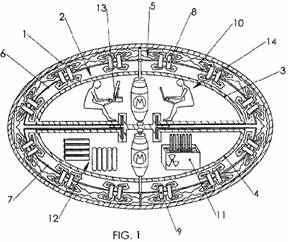


Maybe the title’s “antigravity spaceship” aim is too high (it’s a long way ’till there), but Tesla, followed by other scientists along the last century, discovered the principle of propulsion using strong electromagnetic fields. It’s not about traveling on the ground, but from the ground up, with extraordinary speed and ease.
The entire document is posted on panaceauniversity.org/D8.pdf, here is a short description of what the “spaceship” does and how it can be built, as described by Patrick J. Kelly (update: the document I mentioned in 2008 doesn’t exist anymore) :
“Tesla performed an experiment in which he applied high-voltage high-frequency alternating current to a pair of parallel metal plates. He found that the ‘space’ between the plates became what he described as “solid-state” exhibiting the attributes of mass, inertia and momentum. That is, the area transformed into a state against which a mechanical push could be exerted. This implied that, using this technique, it should be possible to produce a spaceship drive anywhere in space, if the mechanism for thrusting against the ‘solid-state’ space could be determined. Further experiments convinced Tesla that powerful electromagnetic waves could be used to push against (and pull against) what appears to be ’empty space’. The drive principle is based on the Hall-effect used in semiconductor magnetic sensors, and is called the magnetohydrodynamic (“MHD”) effect. This might be illustrated like this:
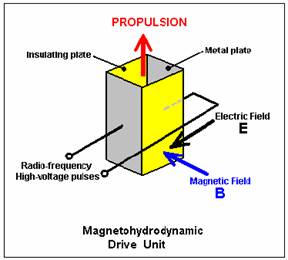


Here, a box is constructed with two metal plates forming opposite sides and two insulating plates holding them in position and surrounding an area of ‘space’. High-frequency, high-voltage alternating current is applied to the metal plates and this creates an electric field “E” acting between the plates as shown in black.

A magnetic field “B” is generated by the electrical field. The magnetic field acts at right-angles to the electric field, as shown in blue. These two fields produce a propulsion thrust “F” shown in red in the diagram. This propulsion force is not produced by ejecting any matter out of the box, instead, it is produced by a reaction against the ‘solid-state’ condition of space-time caused by the high-frequency electromagnetic pulsing of that area of space. This is enormously more effective than a jet engine. The thrust increases with the fourth power of the frequency, so if you double the frequency, the effect is sixteen times greater.

To put this into perspective, consider the force being applied against gravity to lift an object into the air. The force pulling the object downwards is gravity and its strength is given by:

Gravitational force:

F = g x M x m / r2

where

G is the gravitational constant (6.672 x 10⁻⁸ cm3 g-1 s-2)

M is the mas
s of the first body

m is the mass of the second body and

r is distance between the two centres of mass

The lifting force is given by:
Lorentz Force: Force on an object = Electric force + Magnetic force

F = q x E + q x v x B

where

q is the charge on the object,

B is the magnetic field,

v is the velocity of the object and

E is the electric field


How do these forces compare? Well, the electromagnetic force is stronger than the gravitational force by a factor of about 2,200,000,000,000,000,000,000,000,000,000,000,000,000 times. That number (2.2 x 1039) is too big for anybody to really visualise, so let me put it another way.

If the amount of energy used to mechanically lift an object a distance of one hundredth of an inch (one quarter of a millimetre) off the ground, were used as an electromagnetic lifting force, then that amount of energy would lift the object more than 3,472,222,000,000,000,000,000,000 miles off the ground, or in metric units, more than 5,588,001,700,000,000,000,000,000 kilometres off the ground. This kind of drive is an entirely different kind of animal. This Hall-effect type of drive if used in a spaceship would require only a very small amount of input power to drive the ship at great speeds and over great distances.


As the device shown above operates directly on the space-time field which penetrates all matter, there would appear to be no reason why it should not be used to drive a conventional vehicle by positioning it in a horizontal position rather than the vertical position shown in the diagram. Throttle operation could be by very slight adjustment to the frequency of the AC pulses applied to the metal plates. However, Bill Lyne indicates that horizontal movement is better achieved by producing Tesla’s very short, high-voltage high-frequency DC pulses at the front of the vehicle while at the same time generating very high-voltage high-frequency AC waves at the back of the vehicle. This style of drive is said to pull the vehicle along rather than push it along.
Tesla’s Dynamic Theory of Gravity (1897) states that all bodies emit microwaves whose voltage and frequency are determined by their electrical contents and relative motion. He measured the microwave radiation of the earth as being only a few centimetres in wavelength. He said that the frequency and voltage were influenced by the velocity and mass of the earth, and that its gravitational interaction with other bodies, such as the sun, was determined by the interaction of the microwaves between the two bodies.
If you find the concept of producing a driving force through pushing against the space-time continuum to be difficult to accept, then perhaps you should consider the US Patent granted to Boris Volfson on 1st November 2005. The important thing about this patent (which is crammed full of long words) is not whether or not it presents a realistic mechanism for a practical space drive, but the fact that the US Patent Office in the year 2005, granted the patent after what presumably was careful consideration. With that in view, it is hardly possible to consider Tesla to have been totally confused when he designed (and built) his “electric flying machine” which operated by pushing against the space-time field.
Tesla used high voltage at gigahertz frequencies for his electropulsion system. The propulsion of a vehicle powered by a Tesla drive is by the use of an additional AC generator at the back (which stiffens the space-time continuum behind the vehicle) and a DC ‘brush’ generator at the front (which weakens the space-time continuum in front, causing the vehicle to be pulled forwards).
Tesla was very astute. He deduced that ’empty space’ actually contained:

1. Independent carriers which permeate all space and all matter and from which all matter is made. These carry momentum, magnetism, electricity or electromagnetic force, and can be manipulated artificially or by nature.

2. ‘Primary Solar Rays’ (starlight) which travel at the speed of light, having frequencies far above X-rays, gamma and UV radiation.

3. ‘Cosmic Rays’, particles in space propelled by the Primary Solar Rays.

4. X-rays, Gamma rays and UV electromagnetic waves, all of which travel at the speed of light.

5. Ordinary visible and Infra-Red electromagnetic waves which travel at the speed of light.

6. Rapidly varying electrostatic force of enormous potential, emanating from the earth and other gravitational bodies in space.

When we grasp the actual nature of the universe, it becomes clear that we have a much larger range of opportunities for producing usable energy in large quantities and at minimal cost.”

MATERIALS OF CONSTRUCTION


The radical new material, called a metal matrix composite, was developed with the US Army and could be used in everything from warship to cars.

HOW IT IS MADE
The syntactic foam captures the lightness of foams, but adds substantial strength.
The secret of this syntactic foam starts with a matrix made of a magnesium alloy, which is then turned into foam by adding strong, lightweight silicon carbide hollow spheres developed and manufactured by DST.
A single sphere's shell can withstand pressure of over 25,000 pounds per square inch (PSI) before it ruptures—one hundred times the maximum pressure in a fire hose.


The new material also promises to improve automotive fuel economy because it combines light weight with heat resistance
Although syntactic foams have been around for many years, this is the first development of a lightweight metal matrix syntactic foam.
'This new development of very light metal matrix composites can swing the pendulum back in favor of metallic materials,' said Nikhil Gupta, an NYU School of Engineering professor in the Department of Mechanical and Aerospace Engineering and the study's co-author.


It was created by Deep Springs Technology and the New York University Polytechnic School of Engineering.


'The ability of metals to withstand higher temperatures can be a huge advantage for these composites in engine and exhaust components, quite apart from structural parts.'


The magnesium alloy matrix composite is reinforced with silicon carbide hollow particles and has a density of only 0.92 grams per cubic centimeter compared to 1.0 g/cc of water.


Not only does it have a density lower than that of water, it is strong enough to withstand the rigorous conditions faced in the marine environment.Significant efforts in recent years have focused on developing lightweight polymer matrix composites to replace heavier metal-based components in automobiles and marine vessels.


The technology for the new composite is very close to maturation and could be put into prototypes for testing within three years.


Amphibious vehicles such as the Ultra Heavy-lift Amphibious Connector (UHAC) being developed by the U.S. Marine Corps can especially benefit from the light weight and high buoyancy offered by the new syntactic foams, the researchers explained.


The syntactic foam made by DST and NYU captures the lightness of foams, but adds substantia strength.

CURRENT  DESIGN OF  AN ENGINE SUITABLE FOR A FLYING  AIRCRAFT CARRIER


The first X-45A Unmanned Combat Air Vehicle (UCAV) technology demonstrator completed its sixth flight on Dec. 19, 2002, raising its landing gear in flight for the first time. The X-45A flew for 40 minutes and reached an airspeed of 195 knots and an altitude of 7,500 feet.


Credits: NASA Photo / Jim Ross Flying ships invulnerable to super cavitating torpedos


The Joint Unmanned Combat Air Systems (J-UCAS) program was a joint DARPA/Air Force/Navy effort to demonstrate the technical feasibility, utility and value for a networked system of high performance, unmanned air vehicles to effectively and affordably prosecute 21st century combat missions, including

suppression of enemy air defenses, surveillance, and precision strike within the emerging global command and control architecture. One of the aircraft systems evaluated was the Boeing X-45A, for which NASA Dryden provided technical expertise and support facilities.

Friday, June 14, 2024


HIT ALL RUSSIAN ASSETS CLOSE TO FLORIDA COAST BEFORE THEY ESTABLISH A PERMANENT CUBAN BASE


“The Russians have been more active than we’ve seen them in years,” Army Gen. Chris Cavoli, the top commander for NATO and U.S. military operations in Europe, told Congress on Wednesday of Moscow’s undersea capabilities. Russia’s nuclear-powered submarine is now deployed in American waters. The Kazan 561 or K-561 is an advanced Russian Yasen Class nuclear-powered cruise missile submarines. Operated only by Russia, Yasen class submarines are the newest subs in the Russian navy and are known for their sophisticated design, armament, and stealth capabilities. Is its deployment bringing US and Russia to the brink of war.


“Their patrols into the Atlantic and throughout the Atlantic are at a high level most of the time, at a higher level than we’ve seen in years,” Cavoli testified before the House Armed Services Committee. “And this, despite all the efforts they’re undertaking in Ukraine.”


Cavoli’s assessment represents a grave warning for future threats Russia may pose to the U.S. and Ukraine’s other western backers. Though analysts have expressed concerns about Russia’s submarine forces in recent weeks, they have largely centered on the recent attention the Kremlin has focused on its Pacific Fleet, which conducted massive drills last week and which Moscow analyzed and claimed last week has “high readiness.” Those maneuvers were seen in part as an acknowledgement of Moscow and Beijing’s increased partnership.


Putin previously raised concerns in the West in January when he dispatched surface warships to the Atlantic Ocean, including those the U.S. believes can fire hypersonic weapons potentially capable of defeating American missile defenses. Russia fields 11 ballistic missile submarines, which analysts previously assessed it deploys largely off its Arctic coasts.


Cavoli’s comments come at a time of growing consensus that Russia has severely harmed several key elements of its military power through President Vladimir Putin’s decision to invade Ukraine in February 2022 without provocation. A string of high-profile and embarrassing failures since then have exposed endemic issues within the Russian Ministry of Defense, particularly deeply rooted corruption among top commanders, logisticians and those overseeing stockpiles. And confusion and mismanagement on the battlefield has created a veritable meat grinder for Russian ground forces, despite Putin’s decision to continue pressing young men into service and sending them into the fight.


Russia continues to benefit from the sheer size of its forces, as seen in the persistent, grinding combat around cities such as Bakhmut in Ukraine’s east. But analysts have increasingly highlighted the core problems that plague its ground troops.


“Russian forces in Ukraine are operating in decentralized and largely degraded formations throughout the theater, and the current pattern of deployment suggests that most available units are already online and engaged in either offensive or defensive operations,” the independent Institute for the Study of War, which has fastidiously tracked Russian military movements in and around Ukraine, concluded in an analysis note on Sunday.


“It is highly likely that the majority of Russian elements throughout Ukraine are substantially below full strength due to losses taken during previous phases of the war,” the institute stated.


The grave warnings also come as a growing number of Republican lawmakers – and several leading GOP presidential candidates – question the value of U.S. support for Ukraine, saying those resources should instead focus on deterring China.


Rep. Mike Waltz of Florida, a former Green Beret commander, employed this argument on Wednesday, questioning Assistant Secretary of Defense for International Security Affairs Celeste Wallander, who testified alongside Cavoli, about the need to continue dedicating resources to Ukraine when Russia’s military has been devastated.


“Its ground forces that are in Ukraine have been devastated,” Wallander pushed back. But she added that “Russia still retains strategic capabilities” – its nuclear force, the world’s largest – “an air force, cyber and underwater.”


“We should not make the mistake of underestimating Russia’s military capabilities,” Wallander warned, “because the stakes of getting it wrong are too high.”


Sunday, June 9, 2024


COULD THE USAF   USE  STARSHIP SPACE X FOR A FULL   ATTACK  AT CHINA

In 2021, the Air Force Research Laboratory kicked off its Rocket Cargo Program, which aims to use commercial rocket applications to rapidly deliver military cargo anywhere in the world in under an hour. This concept was considered so potentially significant that the Air Force itself quickly established the Rocket Cargo effort as one of just four Vanguard Programs — the branch's highest priority technological efforts. And while SpaceX's Starship may not be the only potential platform for the job, it may prove to be exactly what the Air Force and Space Force need to revolutionize military logistics.

US military eyes SpaceX Starship for 'sensitive and potentially dangerous missions': report


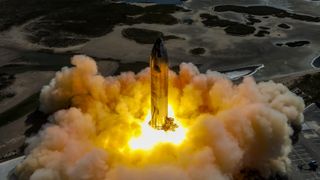
The Starship upper-stage prototype Ship 28 conducts a six-engine static fire test on Dec. 20, 2023. (Image credit: SpaceX)
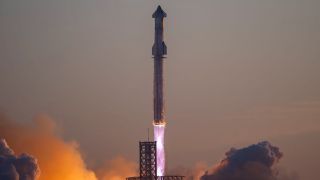


The U.S. military is considering commandeering SpaceX's reusable Starship rocket for dangerous or sensitive missions.


The U.S. Department of Defense (DOD) has reached out to SpaceX to inquire about using Starship on its own, flying the massive rocket as a "government-owned, government-operated" asset on "sensitive and potentially dangerous missions," according to a recent report in Aviation Week.


Currently, the DOD contracts SpaceX as a launch services provider; in this new proposed arrangement the Pentagon would actually take control of the vehicle on its own.


PLAY SOUND


Aviation Week cites comments made on Tuesday (Jan. 30) by Gary Henry, a Senior Advisor for National Security Space Solutions at SpaceX, during the 2024 Space Mobility Conference held in Orlando, Florida.


"We have had conversations … and it really came down to specific missions, where it's a very specific and sometimes elevated risk or maybe a dangerous use case for the DOD where they’re asking themselves: 'Do we need to own it as a particular asset … SpaceX, can you accommodate that?'" Henry said at the conference.

"We've been exploring all kinds of options to kind of deal with those questions," Henry added.


Starship launches on its second flight test on Nov. 18, 2023. (Image credit: SpaceX)

The DOD has been considering using Starship for years. As early as 2020, U.S. Transportation Command (USTRANSCOM) was discussing using the giant reusable rocket — which is not yet operational — for transporting cargo or even personnel rapidly around the world.

"Think about moving the equivalent of a C-17 payload anywhere on the globe in less than an hour. Think about that speed associated with the movement of transportation of cargo and people," former commander of USTRANSCOM Gen. Stephen Lyons said in Oct. 2020. "There is a lot of potential here, and I'm really excited about the team that's working with SpaceX on an opportunity, even perhaps, as early as '21, to be conducting a proof of principle."

Col. Eric Felt, director of space architecture for the Office of the Secretary of the Air Force for Space Acquisition and Integration, added that "there might be some use cases where there needs to be a government-owned, government-operated [vehicle], and that transfer can happen on the fly," Aviation Week reports.
RELATED STORIES:


SpaceX founder and CEO Elon Musk has even hinted at using Starship to send 1,000 human passengers on point-to-point flights around the world at hypersonic speeds held in place by amusement-park-like restraints. "Would feel similar to Space Mountain in a lot of ways, but you'd exit on another continent," Musk wrote on X in 2019.

Aside from potential U.S. military applications and its traditional usage as a commercial launch vehicle, Starship is being tapped for NASA's Artemis program. The agency plans to use Starship as a moon lander to ferry human crews to and from the lunar surface, beginning with the Artemis 3 mission no earlier than 2026.

A lot of development and testing has to go right before that can happen, though. SpaceX will first have to conduct a successful demonstration in which Starship will be used as an orbital refueling platform to top off a human lander after it uses most of its fuel after it leaves Earth and heads to the moon.

Starship is SpaceX's next-generation launch vehicle that the company hopes will help humanity build settlements on the moon and Mars. The massive rocket has flown on two test flights to date; one in April 2023 and again in November 2023. A third test flight could come as soon as February 2024, pending regulatory approval from the U.S. government.


Deployed to Okinawa, Japanese F-35 Fighters Take Up an Anti-China Mission

The U.S. Marine Corps’ F-35B—its version of a fighter being fielded by the Air Force and Navy—has vertical landing capabilities, but those may have compromised some aspects of the Lightning II’s performance.


Here's What You Need To Know: If Chinese ships and aircraft can isolate the Senkakus, then it will be easy for Chinese troops to occupy them. And very difficult to Japan to recapture them: the special amphibious brigade created by Japan would be a sitting duck. But even a few F-35Bs operating from rough airstrips—and perhaps armed with hypersonic anti-ship missiles—could disrupt a Chinese amphibious landing.


Japan may deploy its new F-35 stealth jet fighters to an airbase in southwestern Japan.

The location is not coincidental: Nyutabaru Air Base, in Miyazaki Prefecture, is situated nearer to Japanese islands and waters claimed by China.


“The envisioned deployment of the aircraft to Nyutabaru Air Base is aimed at keeping in check China’s maritime assertiveness around the area, including the Japanese-controlled Senkaku Islands in the East China Sea,” according to an article in the Japan Times. China claims the islands, which are located near China and Taiwan, as its own, and has repeatedly sent ships and aircraft into the area.


A former Japanese military officer recently made waves after saying he believes China plans to invade and annex Taiwan by 2025 and Okinawa by 2045.


The comments by retired Lt. Gen. Kunio Orita, a 35-year veteran of the Japan Air Self-Defense Force and a former commander of the 301st Tactical Fighter Squadron and 6th Air Wing, appeared last month in the English-language Taiwan News.

Orita, who retired in 2009 and is now a guest professor at Toyo Gakuen University in Tokyo, recently told Stars and Stripes he expects Beijing will attempt to expand its sphere of influence by first taking control of Taiwan and then militarizing a key disputed islet in the South China Sea.

Once that’s accomplished, he said, China will set its sights on Japan’s southern island prefecture, which hosts about half of the approximately 54,000 U.S. troops serving in Japan.

Beijing plans to force the United States out of Okinawa by fostering negative media coverage and supporting the anti-U.S. military protest movement on the island, the former general said.

“If China can push out the U.S. military from the region, it is possible that they can conquer the South China Sea and they will gain the power to stop any trade between Japan and other countries,” he said in a phone interview with Stars and Stripes on Jan. 28.

Shoal strategy The key to making this happen is building a naval port at Scarborough Shoal, an islet about 200 miles west of Manila in the South China Sea, Orita said. Beijing took control of Scarborough’s resource-rich lagoon from the Philippines in 2012.

“By building up their forces there, it will add tremendous pressure on surrounding countries,” he said, adding that China backed off plans to militarize Scarborough as it’s done on other South China Sea islets after U.S overflights of A-10 Thunderbolt IIs in April 2016.

A pair of B-52 bombers flew past the shoal in June, drawing condemnation from Beijing, according to The Associated Press.


This will begin with China declaring a no-fly zone around the island nation, he said, adding that any aircraft that tries to come to Taiwan’s aid will be shot down.

Orita then expects Beijing to provoke and attack Taiwanese navy and air force assets, both on land and in the Taiwan Strait, which separates it from China. Next, he expects them to blockade the island until Taiwan’s government agrees to come to the negotiating table, where a pro-Beijing regime will be installed.

“After taking over Taiwan, China will gain more influence over Indo-Pacific shipping lanes, then China can start to add nuclear pressure on the countries in the Pacific,” he said.


DEFENSE OF TAIWAN, ARCTIC AND NATO BY 82  MODIFIED 747 MISSILE CARRIERS: AVOID US NAVY SHIPS IN THE INITIAL ENGAGEMENTS: SPACE X ROCKETS CAN DELIVER MISSILES ACROSS THE PACIFIC FROM T HE WEST COAST IN LESS THAN AN HOUR ECONOMICLY


I like the theory, and what if they used the 747 platform as a mass anti-air AMRAAM platform, it would be a decent counter to Chinese numerical superiority. They could be guarded by a few F-16's/F-35s etc and the AWACS could guide them with a software update to target hostiles singularly. Stealthy cruise missiles fired from a large platform at a very safe distance actually represent a better chance of penetration than risking a stealth bomber flying directly into contested, hostile territory. Ground based radars in long wavelength may well make "stealth" bombers moot very quickly.  Stealthy cruise missiles fired from a large platform at a very safe distance actually represent a better chance of penetration than risking a stealth bomber flying directly into contested, hostile territory. Ground based radars in long wavelength may well make "stealth" bombers moot very quickly.

STATION ABOUT 30 CARGO BOMBERS LIKE BELOW IN JAPAN THAT COULD TAKE CARE OF THE DEFENSE OF TAIWAN SENKAKUS AND OKINAWA


The Airforce is doing this with palletized munitions on cargo aircraft. It allows them to turn C-130 and C-17s into missile trucks. A C-130 has a very low cost/flight hour and C-17 is comparable to a 747. And there are other platforms this could potentially work for, C-390 or A-400 for instance. This project doesn't require any modification of existing platforms. I wouldn't think the Airforce at this point would want to buy a legacy Aircraft for a suedo bomber conversion. But this was an interesting program.I visited the flight deck of a Cathay Pacific 747-400 on a flight from Paris to Hong Kong. It was a surprising experience to be flying over Russia, because the first time I went to Europe was before the USSR dissolved. I didn't get to see the landing from the flight deck, but watching the wingtip of the Jumbo skim the rooftops on approach into Kai Tak was something that I won't forget. Last year, I had a seat on the top deck of one of the last Qantas 747-400 flights from Haneda to Sydney. I did get to see Airforce One land in Canberra. I think it's the only one of those modified 747s ever to land in Australia.


Orita said China will then take the nearby Senkaku Islands, a disputed chain northeast of Taiwan and northwest of Japan’s Miyako island in the East China Sea also claimed by Japan and Taiwan, and encourage Okinawans to declare their independence from Japan.

The Chinese have long been antagonistic regarding the Senkakus.

In 2016, China sailed an aircraft carrier between Miyako and Okinawa’s main island. There have been frequent overflights of Chinese military aircraft in the same space since then, Japanese defense ministry officials told Stars and Stripes last year.

“China keeps pushing up the territorial line every year by breaking into Miyako-Okinawa,” Orita said.

The communist super power has also been “dumping money to influence Okinawa to turn its back on its country,” he said, in a reference to the island’s fervent anti-U.S. military movement.

Orita said he’s learned through intelligence sources that this includes funneling money to Okinawan media outlets for anti-U.S. military coverage. However, he could not provide proof of the assertion.

“China wants Okinawa to be an independent country,” he said. “An independent country does not need U.S. forces on the island.”

Dissenting opinions However, the retired general’s opinions are not universally accepted among Japanese academics. Aomori University professor Hideki Hirano told Stars and Stripes the comments were outlandish and questioned whether Orita had even said them.

Scholar, defense expert and former Japan Ground Self-Defense Force Lt. Gen. Toshiyuki Shikata said he agrees with Orita’s principles, but not his timeline.

“I don’t think Taiwan will be taken by military force by 2025,” he said. “China may use economic pressure as well as influencing the Taiwanese government and its people within instead.”

Shikata said he believes China would take Scarborough Shoal first and then move to take Taiwan, not the other way around.

“I believe China will expand its influence over Taiwan and Scarborough Shoal at the same time, as both are necessary for China to move toward the Senkakus,” he said.

However, if the Chinese do take Taiwan in the coming years, Shikata agreed that attempts to capture Okinawa are possible by 2045.

“China has been influencing Okinawa to become anti-U.S. military and anti-Tokyo,” he said. “China has been using the [protest] movement in Okinawa very well.”

Okinawan protest leaders have scoffed at assertions that their movement, which aims to reduce the island’s U.S. military footprint, has been co-opted by Beijing.

“If the Senkakus get taken over, the U.S. won’t be able to stop China,” Shikata said.

Neither Japan’s Defense Ministry nor Okinawan prefectural officials would comment on the former general’s statements.

A spokesman from the Office of the Secretary of Defense also would not comment specifically on Orita’s statements but said the Defense Department will “continue to pursue a constructive, results-oriented relationship with China.” It also will not accept policies or actions “that threaten to undermine the international rules-based order.”

“We will cooperate where our interests align, and compete, vigorously, where our interests diverge,” spokesman Marine Lt. Col. Christopher Logan wrote in an email to Stars and Stripes on Jan. 29.


“We have a vital interest in upholding the current rules-based international order, which features a free, prosperous, and democratic Taiwan. The objective of our defense engagement with Taiwan is to ensure that Taiwan remains secure, confident, free from coercion and able to engage in a peaceful, productive dialogue to resolve differences in a manner acceptable to people on both sides of the Taiwan Strait.”

Friday, June 7, 2024


The Navy Got Closer to Building Flying Submarines Than You Might Think


What happened to the Navy’s flying submarine concept?

In Variant 1, the personnel compartment for special operators was placed forward of the cockpit, as these compartments would flood during submerged operation, placing the pressurized cabin as close to the vehicle’s center of gravity as possible.


In this configuration, the vehicle’s batteries are stored on either side of the personnel compartment, in line with the turbofan engines.

Operators would deploy through a large hatch on top of the vehicle near the equipment locker. Both turbofan engines would be placed far to the rear and as close to the centerline of the vehicle as the cabin would permit, though the study points out that analysis should be done regarding performance during a single-engine failure. If the engines were mounted too far apart and one were to fail, it could place the flying submarine in an unrecoverable flat spin — a problem that cost the Navy as many as 40 F-14 Tomcats.


This arrangement resulted in an exterior appearance that was more triangular in shape than the alternative, explaining its slightly longer dimensions.


Variant 2, on the other hand, sought an even lower profile along the vehicle’s centerline, accomplished by distributing equipment and personnel across a wider area. As discussed in earlier sections, the personnel compartment carrying special operators would be split in two, placing three operators on each side of the pressurized cabin in reclined chairs to maximize headroom while minimizing height.


This design places the turbofan engines, ballast tanks, air pressure system, and some other components in the same places as Variant 1.

The batteries in Variant 2 are placed ahead of the pressurized cabin and between the personnel compartments. Operators would again exit through hatches on top of the vehicle, but would have to swim to its rear to grab their bags, scooters, and other mission-specific equipment.

The result is a shorter, wider exterior design with a slightly lower centerline. This arrangement proved heavier, due to its added width and associated fairing.

How to Take a Flying Submarine to War


According to DARPA’s Concept of Operations and the conclusions drawn by the Navy’s study, the following is an approximation of a flying submarine could be leveraged in covert operations.

The vehicle would be deployed by any surface vessel large enough to carry it and equipped to place it in the water. Two vehicle operators (pilots) would enter the pressurized crew compartment and begin their pre-flight checks as the Navy SEALs or other special operations divers donned their equipment and stored the rest in the vehicle’s gear locker.

Once the flying submarine was in the water atop two specialized inflatable floats that eliminated the suction effect a hull can have on the surface, its two turbofan engines would propel the vehicle to 100 knots, at which point, the unusual aircraft and all on board would take to the sky.

Once airborne, a lightweight fly-by-wire control system fed through a flight control computer would manage the aircraft’s twin-flap control surfaces that allowed roll-independent yaw control, thus eliminating the need for a vertical tail. The vehicle would remain airborne until it was approximately 12 nautical miles from shore, which is the conventional limit of territorial waters. In other words, even if someone were to spot the aircraft flying along its route, it would be seen flying over international waters.

Using the same inflatable floats, the flying submarine would land on the surface of the water. If necessary, the vehicle could then traverse further on the surface of the ocean, turning through modulating the output of the turbofan engines independently. It would then deflate its floats and fill its ballast tanks, submerging the vehicle and flooding all compartments except the pressurized cabin.

The SEALs inside, donning wetsuits and completely submerged in water, would draw breath from the same high-pressure air system that keeps the cabin pressurized and refills the vehicle’s floats. Based on industry capabilities in 2010, the study posits that storing enough air to meet all operational requirements internally would be entirely feasible, so there would be no need for any means of refilling the air tanks.

The vehicle would then deploy its underwater propulsion pod, using an electric motor to propel it forward and a combination of the motor’s orientation and the vehicle’s flight control surfaces for maneuvering. As Rick Goddard and Jonathan Eastgate explained in the Submersible Aircraft Concept Design Study, “It is envisaged that the pilot will be assisted by a flight control system acting between the manual yoke inputs and the final flap deflections and that this system should be able to deal with the smaller deflections needed for underwater maneuvering.”

The flying submarine, now more submarine than airplane, would approach the shore fully submerged, opening its hatches and deploying the combat divers while deep enough to avoid detection. Once out of the vehicle, the divers would grab their gear from the equipment locker and travel on using submersible scooters or by swimming to shore.

The special operators would then have 72 hours to conduct clandestine operations in enemy territory while the vehicle’s two pilots remained onboard and fully submerged. Once the special operations team completed their mission, they would return to the water, swimming back to the vessel and reentering it while submerged, reconnecting to its onboard air supply. At which point, the pilots would drive the vehicle back into international waters before surfacing, inflating the floats, and taking off once again to fly back to the ship that deployed it or to a different designated recovery point.


What Happened to the Navy’s Flying Submarine Concept?

After testing a scale model, the Navy’s report concluded that “feasible vehicle concepts can be generated using current technology and materials” to design and build a real special operations flying submarine, but as far as the public is aware, that’s the end of the story.

To be perfectly clear, it’s difficult to say if this study resulted in further development of a flying submarine or if it was quietly shelved alongside other exotic but seemingly feasible programs.

It’s important to remember that the United States was not particularly concerned with Great Power Competition or the possibility of near-peer conflict in 2010. In fact, this study came two years after a different effort to deploy low-observable drones from the vertical launch tubes of Ohio-class ballistic missile submarines was canceled for budgetary reasons and one year before the F-22 Raptor program was canceled after just 186 out of 750 intended fighters were delivered.

To be frank, America’s defense apparatus was funding combat operations in multiple theaters against opponents with no notable air or sea power… so efforts to field stealthy or otherwise highly advanced platforms in either environment were simply not the priority.

It’s possible, however, that development continued on the flying submarine concept at a low volume and scale, and to be honest, the United States may even have some such platforms in service today. After all, the F-117 Nighthawk first took to the skies in 1981, but wasn’t revealed to the public until 1988. Today, America has successfully flown a technology demonstrator for its Next Generation Air Dominance program, assembled three B-21 Raiders, and regularly operates the highly secretive RQ-170, all without most of us getting a good look at any of them. It stands to reason that there are other programs we remain entirely in the dark about.

The Navy may have concluded that it was feasible to build a flying submarine, but that doesn’t mean the Navy felt it was practical. The truth is, if there is such a vehicle in service today, we likely won’t know for years to come… but if there isn’t, the Navy’s engineers had an interesting bit of advice for future endeavors.

According to them, the secret is approaching the problem with the intention of building a submersible aircraft, rather than a flying submarine. Apparently, planes do better underwater than submarines do above it.